
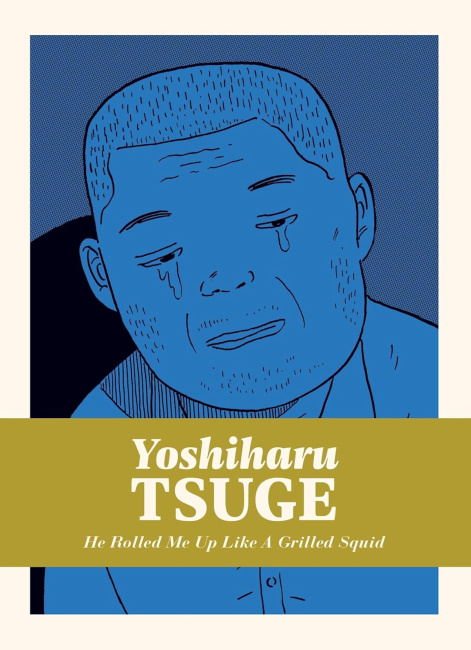

Manga creator Yoshiharu Tsuge died of aspiration pneumonia on March 3, 2026, his family revealed last week. While he was well known as an avant-garde creator in Japan, Tsuge’s reluctance to have his work translated meant that it has only been widely accessible to English-language audiences since 2019. Drawn & Quarterly is currently publishing his complete work, with the newest volume, He Rolled Me Up Like a Grilled Squid, due out on March 31.
Tsuge was born in Tokyo on October 30, 1937, the oldest of three sons; his younger brother, Tadao Tsuge, is also a manga creator.
Tsuge began creating manga in 1955, when he was 18, drawing gritty adult manga for what was then a flourishing manga rental (kashihon) market. As that market began to decline, Tsuge struggled with depression and poverty and attempted suicide. Scholar Paul Gravett tells the story of what happened next in his book Manga: Sixty Years of Japanese Comics: Katsuichi Nagai, editor of the new alt-manga magazine Garo, appealed to Tsuge directly through the pages of the magazine with a notice that said “Yoshiharu Tsuge, please get in touch!” When Tsuge reached out, Nagai introduced him to Shigeru Mizuki, who took him on as an assistant.

Within a year, Tsuge was making his own manga again, and Garo began publishing his work in 1966 with the short story “Numa” (“Marsh”). Rejecting the cinematic tropes of mass-market manga, Tsuge developed a slower, more introspective style that focused on emotions and interior states rather than action. His breakthrough work was the 1968 short story “Nejishiki,” often translated as “Screw Style,” a surreal, disjointed story of an injured boy searching for a doctor through a dreamlike landscape. The work resonated with young adults and helped make his name as a gekiga manga creator. He continued to publish in Garo until 1970, creating a total of 22 stories for the magazine.
After Garo, Tsuge moved in a different direction and made more autobiographical and erotic work. He stopped making manga altogether in 1987, but his work has continued to be collected in multivolume anthologies in Japan.
The first translation of Tsuge’s work in English was the story “Red Flowers,” which appeared in an insert in Art Spiegelman and Francoise Mouly’s Raw magazine; a second story, “Oba’s Electroplate Factory,” appeared in the magazine in 1990. In 2001 some of his work appeared on a short-lived Digital Garo site (see “The Japanese ‘Raw’ Tries Online Sales”), and “Screw Style” was published in The Comics Journal #250 in 2003.

After that, no further translations appeared until 2019, when New York Review Comics published Ryan Holmberg’s translation of The Man Without Talent. In 2018, however, Drawn & Quarterly announced that they had licensed Tsuge’s works (see “SDCC Manga Roundup”), and they began a multivolume series in 2020 with The Swamp, followed by Red Flowers, Nejishiki, and Oba Electroplating Factory, all translated by Holmberg.
Drawn & Quarterly also published My Picture Diary, by Tsuge’s wife, actress and artist Fujiwara Maki, which chronicled the family’s life in the early 1980s, when they struggled with poverty and Tsuge’s debilitating depression (see “Drawn & Quarterly’s Spring 2023 Catalog”). That book won the 2024 Eisner for Best U.S. Edition of International Material—Asia.
Source: ICv2

