
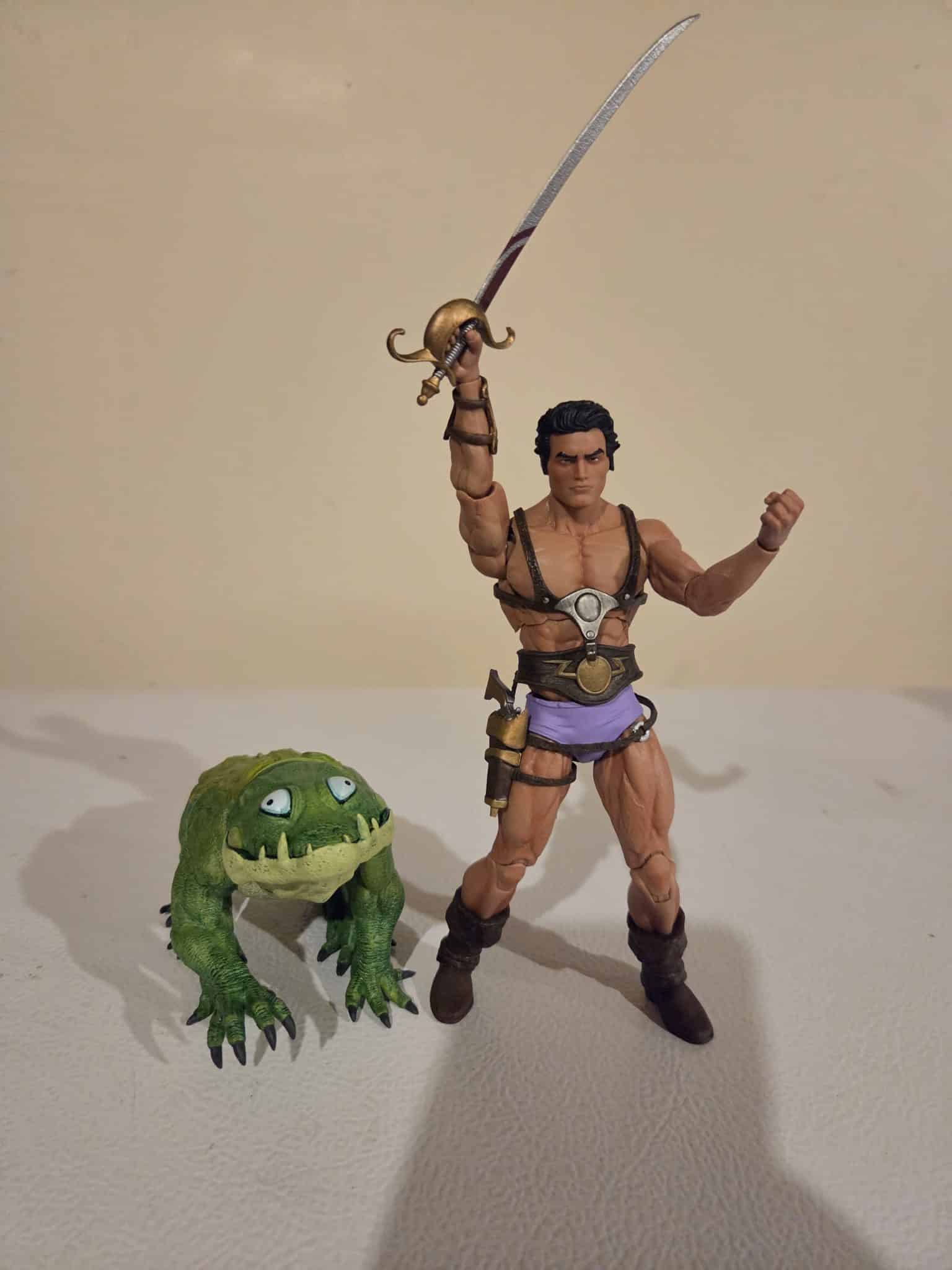
First off, it’s great to be back on Graphic Policy with Super-Articulate! Today, we’re taking a look at the new John Carter set from Frazetta Girls’ ICON™ Collectibles, and we do so with a very special thank you to Sara Frazetta, who made this piece possible.
The Historical John Carter
John Carter debuted in a serialized novel called Under the Moons of Mars in the pages of classic pulp magazine The All-Story in 1912. Carter was the creation of Edgar Rice Burroughs, best known for creating Tarzan of the Apes. That first novel ran from February through July of that year and was later collected in hardcover book form in 1917 as A Princess of Mars. The inhabitants of Burroughs’s Mars referred to their own planet as Barsoom; this is why you’ll see the original 11 Burroughs Carter novels alternately referred to as the Barsoom or John Carter of Mars series. The 11 official novels appeared through a variety of pulp serializations between 1912 and 1964 (on a technicality; the final novel is really two earlier published stories collected together).
Citizens of Graphic Policy might be familiar with some of Carter’s history in comics and comic strips. After a couple of near misses, a John Carter of Mars strip launched on an absolutely TERRIBLE day: December 7, 1941. On the bright side, the strip was written and drawn by one John Coleman Burroughs, the son of Edgar Rice Burroughs himself. John Coleman’s wife Jane Ralston Burroughs also worked on the strip with inks, letters, and background art; she was also her husband’s model for Dejah Thoris. That strip ran until April 8, 1943. Dell Comics anthologized Carter tales in three separate issues of Four Color Comics in the 1950s. From 1972 to 1973, DC Comics picked up Carter tales, also in anthology books; these included appearances in both DC’s ongoing Tarzan book of the time and Tarzan Family, as well as Weird Worlds.
After DC, Marvel had a turn. It picked up the license and ran a John Carter, Warlord of Mars ongoing from 1977 to 1979. The series ran for 28 regular issues and 3 annuals; it also picked up the “Favourite New Title” prize at the 1978 Eagle Awards. The Marvel series was created by two legends: writer Marv Wolfman and artist Gil Kane. They both worked on the ongoing title, as did writers Chris Claremont and Peter B. Gillis and artists Carmine Infantino, Ernie Colon, Larry Hama, Dave Cockrum, Ruby Nebres, and Ricardo Villamonte. The comic was cancelled due to a combination of the license expiring, declining sales, and the fact that Marvel’s Star Wars comic was doing gangbuster sales by comparison.
Since then, Carter has popped up in multiple versions at different companies. He figures into Volume Two of The League of Extraordinary Gentlmen. He had a multi-year run at Dynamite across two books, Warlord of Mars and Dejah Thoris. In 2011 and 2012, Marvel had new swings with tie-ins to the John Carter film and a mini based on the book Gods of Mars. There’s also been a Warlord of Mars webcomic from Edgar Rice Burroughs, Inc. During San Diego Comic-Con 2026, Titan Comics announced a new publishing program with Edgar Rice Burroughs Inc. that will include new editions of classic releases as well as all new releases and even never before seen material.
In terms of live-action, there have only been two notable adaptations of the Carter saga. The first, 2009’s Princess of Mars, was a direct-to-DVD movie starring Antonio Sabato, Jr. as Carter and Traci Lords as Dejah Thoris. Reception was generally poor. The biggest swing at Carter on screen was Disney’s John Carter in 2012, which is generally regarded as a victim of “one of the worst marketing campaigns in movie history.” Reviews were mixed, with audiences giving it a B+ Cinemascore, but publicity over how much money it lost hurt its reputation. It is, in reality, a fun film, directed by Pixar ace Andrew Stanton and starring appealing leads in Taylor Kitsch and Lynn Collins.
The Frazetta Connection
As you know Frank Frazetta was, and remains, a master artist. His reputation in terms of fantasy art is perhaps matchless. And among his subjects was John Carter. Most famous is probably “A Princess of Mars,” which he executed in 1970 for the hardcover version of the novel of the same name. Today, it can be found in the Lucas Museum of Narrative Art. That very same art adorns the box for today’s subject, the John Carter (and Woola!) action figure set from Frazetta Girls.
THE FIGURES
No use burying the lede here: the 1:12 scale John Carter figure from Frazetta Girls is a top-notch piece of work. I had high expectations from the original photos and the sheer amount of accessories advertised, but I was pretty blown away by the products in person. The design elements are thusly on the Frazetta Girls site: Designed by: Eamon O’Donoghue. Sculpted by: Gurjeet Singh. Paint Mater Artist: Mat O’Toole.
The packaging is not always something I care about as a long-term “opener,” but this packaging is striking. As noted above, the front sports “A Princess of Mars,” but the inside of the box as well. If you know anything about production, that’s extra cost and care on the part of the company. One of the interior box walls is also a picture of the figure in addition to more “Princess.” It certainly makes for an eye-catching presentation. Carter, Woola, and the accessories are tucked inside in three plastic trays; one separates Woola, and the other two cover Carter and the accessories.
Included accessories are: three “hairpieces” for three different hairstyles; two heads with different expressions; one helmet; one sword with scabbard; one pistol; an attached pistol holster; one alternate boot style (two pieces); an alternate chest harness; and seven alternate hands, making for nine hands total in a variety of fists, spread-finger positions, and gripping poses.
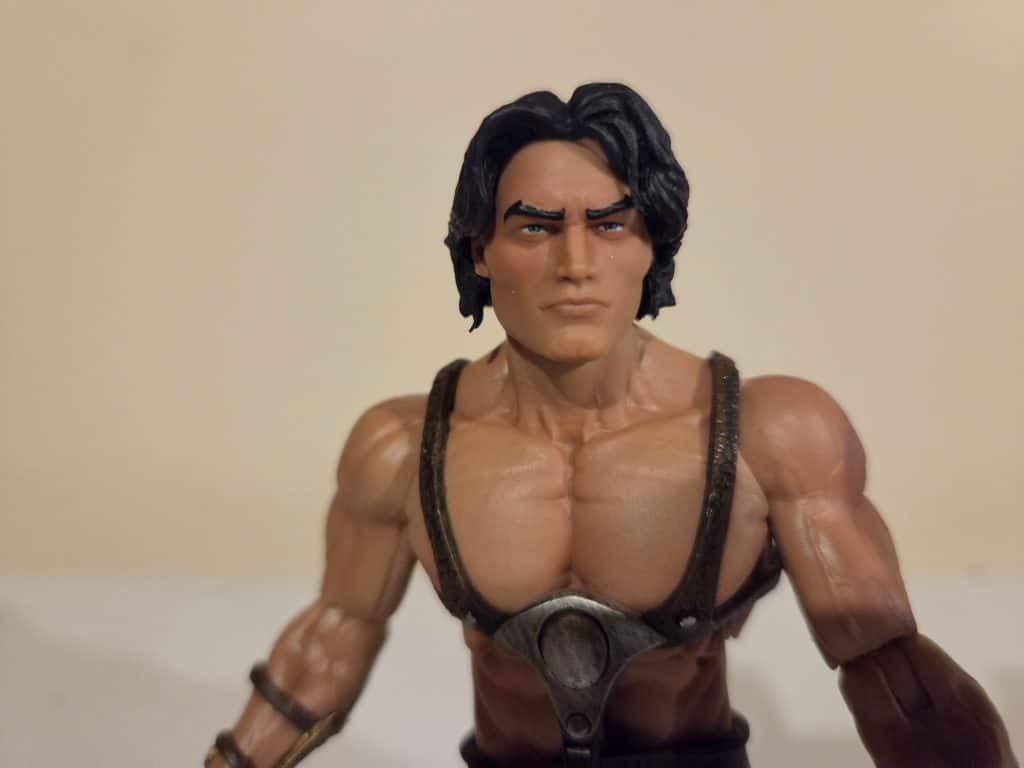
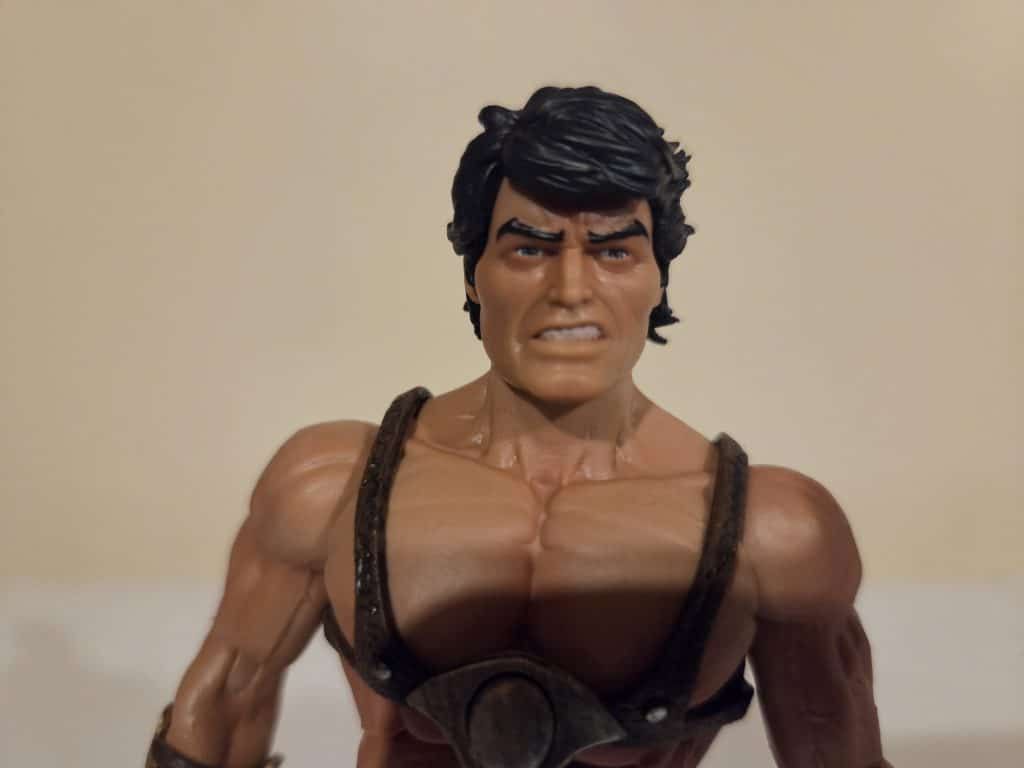
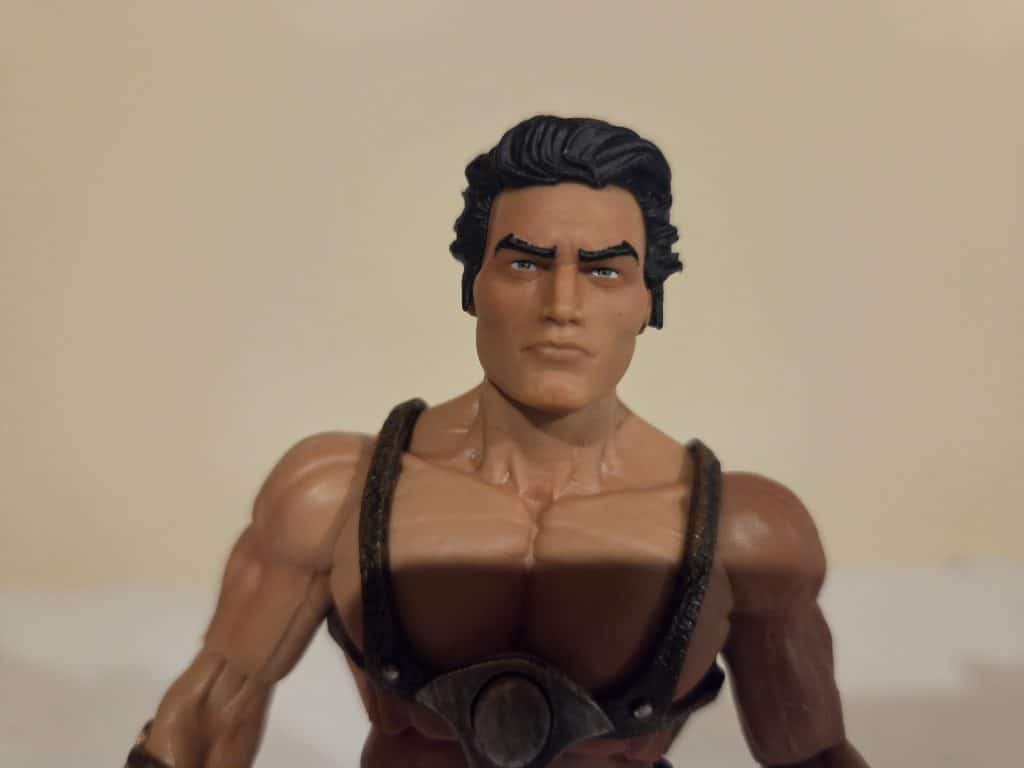
The hairpieces are a pretty innovative approach. Each is pegged to fit a slot on the Carter heads. Look closely, and you’ll see how one style in inspired by the Frazetta painting, and one is very close to how Gil Kane did Carter’s hair in the control art for the Marvel comic of yesteryear. Similarly, the helmet has a peg that fits into the head; yes, that means that you can’t put the helmet over a set of hair, but the helmet has hair sculpted in to give appearance of hair sticking out the bottom when the figure has the helmet on.
The weapons echo what the Carter of the books would have carried. The sword is a cavalry saber appropriate to the Carter’s military service of the time, and the pistol is of the six-shooter variety. A couple of the hands are obviously “gun hands” for a proper pistol grip, and you can easily choose a proper hand for holding the sword. The scabbard has a chain attached on one end that fits into an S-hook at the other, facilitating the wearing of the scabbard by the figure if you so choose.
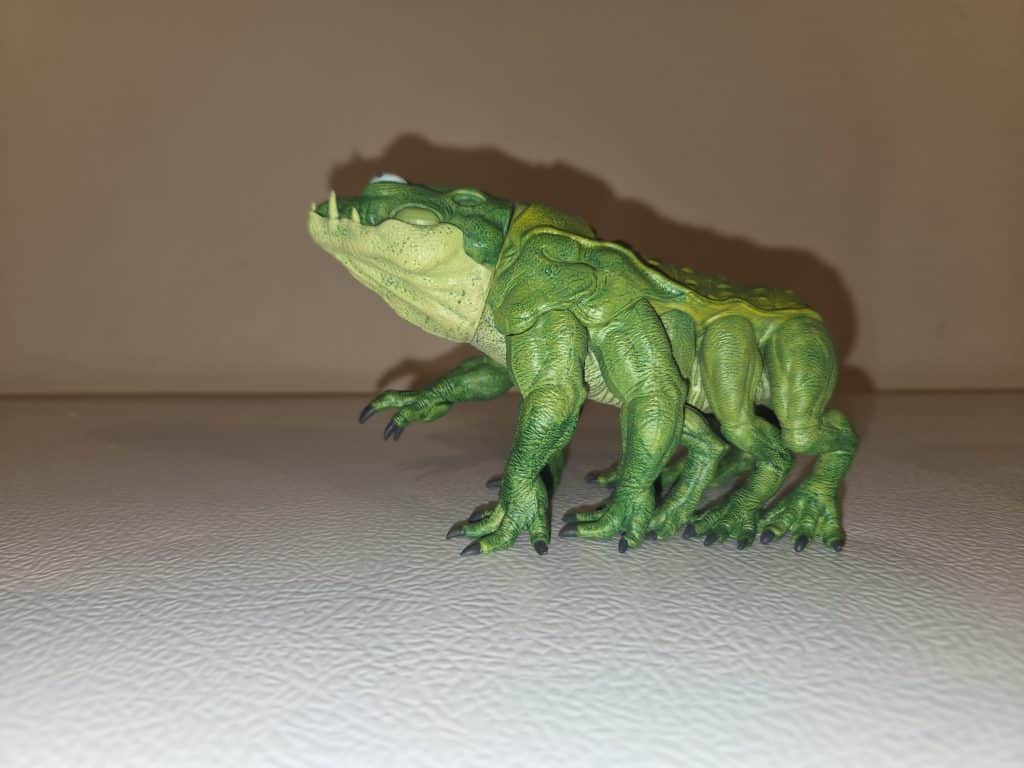
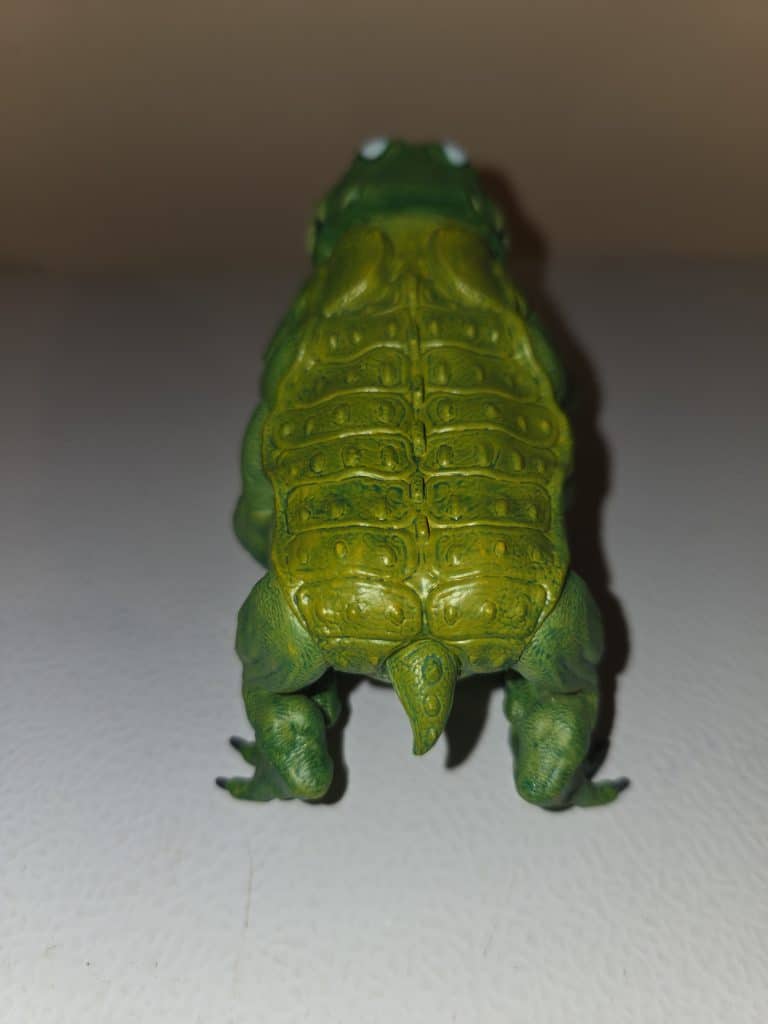
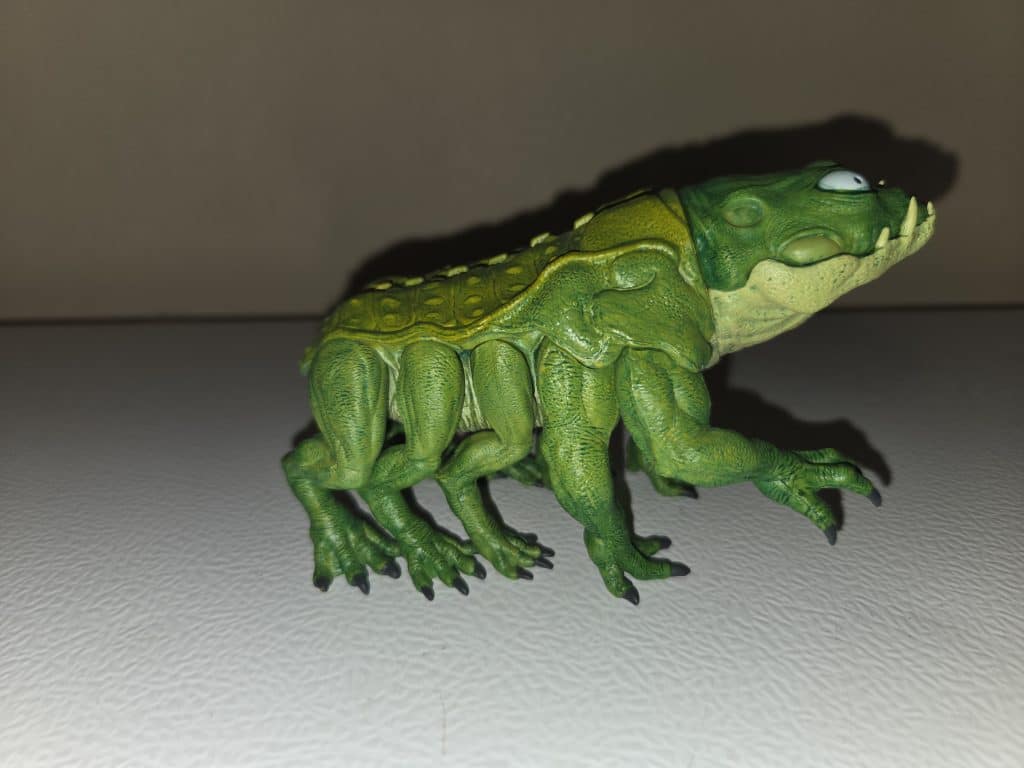
Before getting to Carter, let’s talk Woola. Woola is a Calot, which is a sort of companion animal to the Green Martians. Carter meets Woola soon after his arrival on Mars; the two save one another from a creature they encounter, and Carter’s display of affection ensures Woola’s loyalty. Like all Calots, Woola has 10 legs and multiple rows of teeth. The Woola figure is appropriately scaled to Carter and the paint work in terms of color is great. Woola is not fully articulated (his head does move), but he does come in a fun semi-pose and looks great next to Carter.
In terms of the Carter figure itself, this is a rock-solid sculpt with a lot of articulation. As you can see in the photos, we’ve got pinless arms and legs and double-joints. The figure is poseable at mid-chest as well, allowing for a number of poses. I set up some demo poses with Carter wielding both his sword and pistol. I also did a couple of variations on body position to show the flexibility of the sculpt. It’s strong work.
Again, the alternate heads, hair, and helmet let you choose your favorite look. I opted for one that hews a little closer to that historic Marvel take as I intended to display Carter and Woola next to another character who did time with Marvel in the 1970s: Red Sonja. I decided on the more neutral face versus the more angry/determined expression. Both are really good pieces of work.
Overall, I think this is a terrific job. I honestly think that O’Donoghue, Singh, and O’Toole outdid themselves. John Carter in an important character in popular culture and in the development of both modern science fiction and fantasy. The character deserves to have an excellent figural representation. I’m happy to report that it got one.
Troy Brownfield is the Executive Editor of The Saturday Evening Post and the writer of Marvel Comics for Dummies and X-Men for Dummies. Follow him at troybrownfield.substack.com
Discover more from Graphic Policy
Subscribe to get the latest posts sent to your email.
Source: Graphic Policy
