
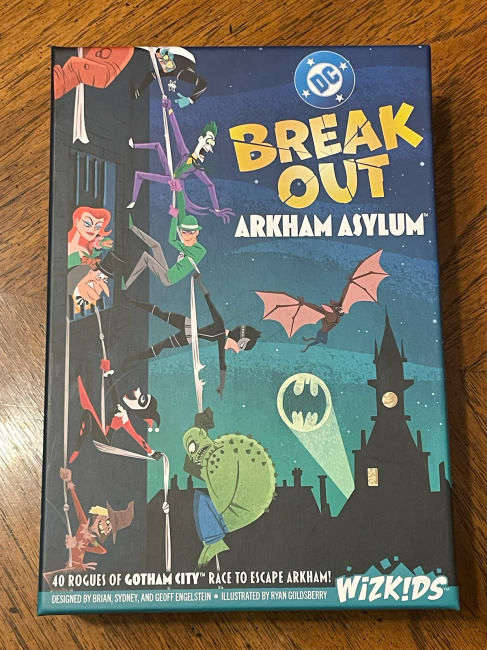

DC Breakout: Arkham Asylum
Publisher: WizKids
Designer: Brian, Sydney, and Geoff Engelstein
Illustrator: Ryan Goldsberry
Number of Players: 2 to 6
Age Rating: 8 and up
Playing Time: 30-45 min.
MSRP: $29.99
Product #: 87642
Release Date: March 2026
ICv2 Rating: 4 Stars out of 5
It’s always been a wonder that they don’t just put revolving doors on Arkham Asylum, considering the frequency with which the inmates suddenly find themselves outside of its walls, only to be promptly deposited again by certain cape-clad crimefighters. But at least the process of escaping can provide some entertainment for the inmates to while away their days. Which brings us to WizKids new board game, DC Breakout: Arkham Asylum. The question is, would the inmates be better served just staying put?
Summary: Capturing the aesthetic of the animated Batman, DC Breakout: Arkham Asylum pits teams of super-villains in a race to see who can reach the exit the fastest. Operating in pairs, the villains make their way through the prison on two related missions: first to grab some supplies, then to make good their escape. The first to complete this second run claims victory and the right to brag about being better villains than their rivals.
Each player is dealt a team of five characters pulled from Batman’s extensive rogues gallery and selects two of them for the first run. A path is formed from board tiles, ending in the “Armory”. Each two-villain team is linked together back-to-back to form a single standee-pawn at the opposite end. Then players take turns moving along the track in what is essentially a “roll your dice and move your mice” mechanic. But it would be unfair to dismiss the game based on this, as every villain has a unique way to bend or break the rules in their favor, and as they race they have opportunities to collect Gadget cards that give even more ways to manipulate fate. Combining these unique abilities is both the heart of the game’s strategy and the key to victory.
The teams that reach the Armory the fastest get the best opportunities to collect more Gadgets. Then each player chooses a different pair of villains for the second run, this time over a slightly longer course. The first to reach the end on this run wins the game.

Originality: The core elements of the game are not revolutionary, but it includes some twists that make the game more interesting than it at first appears. There are 40 villain powers to mix-and-match, creating an almost unlimited pool of combinations. Graphically, the cartoony and sometimes goofy artwork keeps the atmosphere light and fun. Combined with simple mechanics, it’s well-suited to younger audiences and families.
Presentation: The artwork style perfectly captures the light-hearted spirit of the game as well as the source inspiration. The colors are bold and bright, both on the packaging and the components. The ridiculousness of the premise is mirrored in the absurdity of the box cover, depicting super villains using knotted bedsheets to slip out of prison, giving the whole a delightfully appropriate campy vibe that harkens back to iconic scenes of the original televised Batman series. Titles are bold and easy to read, the box back has a lengthy description of the game, and a nice component shot to boot.
Quality: The artwork is solidly consistent throughout. The board is made of nice, extra-thick tiles, and the cardboard standees are robust and solid. The choice of cardboard feet for the standees saves wear-and-tear on the tokens, as they will frequently change between and even during games. The dice are good quality and very color-appropriate for the game. The cards are good, flexible stock, tarot-sized for the villains and poker-sized for the Gadgets. The rules are short and reasonably clear, though I would have liked more practical examples of play, and some of the rules are unfortunately hidden in what appears to be an appendix. But there is a solid rules summary to remind players of what’s what once they’re familiar, and the rules are simple enough that learning how to play poses little challenge.

Marketability: From the style of the artwork and the complexity of the themes and gameplay, this game is clearly intended for a younger audience, more for fans of Batman and their families than experienced game players. Comic book heroes continue to enjoy widespread appeal in pop culture, and I could easily see this being a good gift choice. At the same time, there is just enough tactical decision making that, with the game’s short playing time and low bar to entry, could make this an appealing “filler” game for players who enjoy seeing how different ability combos can influence game play and don’t mind a significant luck factor.
Overall: Keeping in mind the apparent goals for DC Breakout: Arkham Asylum, I think this game does a fine job of hitting its mark. The rules are easy to learn, the concepts are straightforward, gameplay is fast-paced with little downtime, and there is enough randomness to spawn excitement, especially as the villain abilities and Gadgets offer lots of ways for players to catch up from behind and stay “in the race” up to the end.
However, luck plays a big factor in this game. The villains one has to choose from is random. The die rolls controlling movement are random. The Gadgets they draw from the deck are random. The path the villains race along is linear, without branches or meaningful decisions along the way. The abilities give some mechanisms for mitigating this luck to some degree, but in the end, DC Breakout: Arkham Asylum is what it is: a quick and fun romp for younger audiences and players looking for a brief diversion. And I think that’s fine. Sometimes, you don’t want a heavy brain-burner, and kids deserve to have fun too. And that’s why I’m giving this game 4 stars out of 5.
Source: ICv2

