
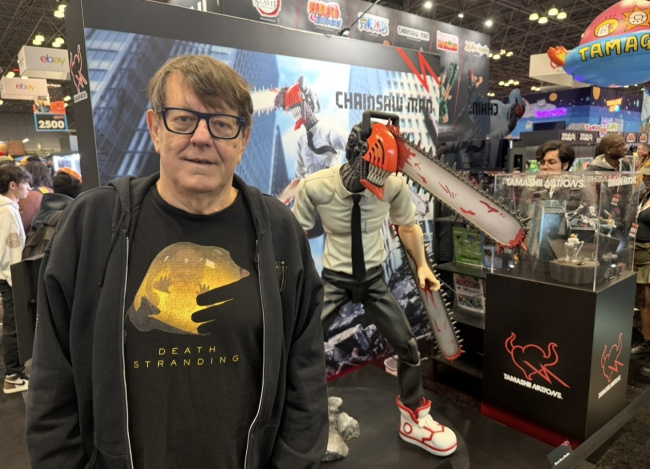

Dreese – another fan at New York Comic Con
Newbury Comics is the largest comic store chain in the U.S. by number of stores, with 30 locations in six Northeast U.S. states. Our interest was piqued after a visit to one of their stores in a tourist area of Boston last fall (see “Explore the Store: Newbury Comics“); the store had a massive selection of merchandise across a wider range of categories than we’d seen in a store of this type in the past, ranging from comics to vinyl to licensed crochet kits. While the store’s comic selection is now a small part of its offerings, we thought there was a lot to learn from this chain, which has been successful and growing over many decades.
Newbury Comics was formed in 1978 by MIT students Mike Dreese and John Brusger; Brusger is semi-retired, we spoke to Dreese, who remains involved with the chain’s real estate and the buying of the most volatile categories. The company’s day-to-day operations are run by two co-presidents.
In Part 2 of this two-part interview, we discuss broken e-commerce platforms, what’s driving growth, the future, and how it all works. In Part 1 we talked about the locations, volume, the customers, keys to success, and product mix. The interview has been lightly edited for length and clarity.
Why are you doing less with Amazon now?
Amazon is (all those platforms are) just nickel and diming everybody. You read every year about Amazon, their advertising revenues are up, up, up. The advertising revenues is what they force third-party merchants to buy in order to get product placement.
As a customer, I was just looking last night for socks from Ted Baker, the British designer, and there’s only three examples. It’s all paid placement before you get to the right stuff.
I think the agentic agents are going to be the death of a lot of that because they’re going to be able to find you exactly what you want, and also maybe the death of us as a retailer. That’s, I think, the single biggest threat out there is these AI agents being able to go fetch stuff you want and eliminate all the advertising garbage you see on Google and Amazon and eBay.
To me, Amazon is a very frustrating place to shop. If you look at the stats on the percentage of total take that goes to Amazon versus third-party merchants, it’s a line that’s just at a 30-degree angle. From 20 years ago to now, it just keeps going up. Every year, they figure out a way to take another half a percent or whatever.
We consider that to be a toxic relationship. They’re not trying to support vendors, they’re exploiting them while running ads every day that say, “Oh, look at Susie’s Q bake shop that’s part of Amazon.”
There’s a reason why all the big merchants don’t represent a significant amount of their business, because it’s a very expensive platform to operate on. Having said that, if you have something really unique, you can still do very well there, but it better be unique.
Combined with all the counterfeits and stuff, that just made it a very, very, very difficult environment to operate in. We at one point had, I think, 60 different Star Wars T-shirts on the platform. Now, it’s just flooded with Temu-type stuff. It’s a broken platform in terms of quality control.
It’s very sad. It’s a major institution that to me is anti-small vendor and definitely anti-consumer because the quality is a problem. They make up for it by very generous returns, which, again, all get charged back to merchants.
It’s very tough. Spectacular marketplace, but very tough. Walmart’s starting to have some of the same problems.
You do still sell online on your own website, right? That looked like it was mostly vinyl.
It’s very little. It’s just these exclusive vinyl pieces. We’ve made, I believe, over a thousand pieces of exclusive colored vinyl.
We used to have 2,000 Funkos. We just took all that stuff down. There’s just no way to make money shipping $30 parcels through the mail at a competitive price unless you own the content, which we do with a lot of exclusive vinyl.
Walmart and Target, they all moved into that space. We, along with the Coalition of Independent Music, sort of pioneered those spaces. Now it’s completely dominated by mass merchants because they’re buying like 10,000 Metallicas at a time. We were trying to buy 2,000 at a time and make them all these swirl patterns and stuff of interest to collectors.
Funko has fallen into what I call manufactured exclusives. This one has a gold foil cover, and to get that, you have to buy a hundred regular ones. That’s not a solid business. That’s an exploitative model.
Funko’s fallen into that trap of “Let’s make massive numbers of exclusives and gate it so you have to go through our store first or have NFTs” and all this other nonsense that’s not at the core of what the consumer wants. It’s what the manufacturer wants to capture consumer information and market directly to them.
Nike, Vans, Converse, all these companies we used to deal with, they’ve all found out the hard way that trying to just become the sole supplier to your customers is not good. It provides an umbrella for upstart brands to grow underneath your “have your cake and eat it, too” model.
You said you’re having a bang-up year this year, what’s that based on? What’s growing?
Blind box lines, trading card lines, build kit lines, these things that are like Lego knockoffs. You build these environments. The Smiskis and Sonny Angels are really popular. They come from the Dreams Corporation. Both sports cards and game cards are still running up 60 to 80 percent above last year. Those are very large numbers now.
Actually, in our stats, we never look at sales. All we measure is gross profit. Our gross margins are now running at least 1.4 what they were two years ago. We don’t expect it to continue. We expect it to go down meaningfully at some point, but it’s been a hell of a run.
We catch these like fidget spinners or the original Pokémon cards (that first series, boy, if I had just kept one skid of those). We sold $2.5 million worth of that first series of Pokémon cards. It was just extraordinary. When that happened, we bonused out huge. We had people in the warehouse crying. We gave them like three or four weeks’ pay. They’re just like, “Oh my god, I can’t believe it. I just got a check for $2,000″ when their weekly pay was $500 at the time or whatever.
What’s the future for Newbury Comics?
That’s a tough one because my partner and I are both aging out. I just turned 70. I’ve been in the business 48 years. We started in ’78. The real question is, is there going to be a space for a reasonable number of enclosed malls in the future? If not, will these freestanding stores continue to thrive at all?
Given the weight of e-commerce and, again, this agentic-type stuff, I have a very dim view of a 10-year time horizon. If you don’t control the IP, I don’t know how you compete with perfect competition.
Right now, if people ask, the main secret sauce of Newbury Comics is spontaneous discoverability. The whole value proposition is, when you walk into a Newbury Comics, you’re going to find something that absolutely delights you that you didn’t realize existed, the true shopping as entertainment, shopping as a discovery.
If you’re trying to have fun on Amazon or eBay, it is very difficult just to search. They have made it so difficult because everything that they’re suggesting is a paid placement. It’s not the latest hip thing. It’s whoever had the most money to buy that slot.
We don’t have those problems. We just present what we think is the coolest across 15 verticals. It’s like an article I just read: it’s like having a museum. Different people like different paintings. You just have to be sure you’re providing enough so it’s worth the price of admission to the museum.
Everybody’s going to respond to different pop culture and different art differently. You better be pretty good at a lot of categories if you want to maintain a center of gravity. There are people who are going to keep returning.
As pop culture shifts from Disney Princess to Spider-Man to manga, you better be able to move that. You’re adding five percent to the leading edge while losing five percent off the trailing edge. That’s just a continuous process. We find most retailers just are not flexible enough to seek out those little, baby vendors.
We have products now where we wire money in advance to get goods. We always have. We are sending six-figure wires out to baby vendors on the West Coast, whatever. Nobody does that, that has our scale, that I’m aware of. There’s just nobody doing that. They all want 60 days, 90.
You hear the horror stories, “I’m trying to get into Urban Outfitters.” We respect Urban Outfitters a lot, but their terms of trade can be very tough on small vendors. Just like Walmart or whatever, there’s no way to fight your way in because they want you to be their bank.
We don’t. We want you to ship us all your best stuff. We’re willing to pay in advance for it. We still do it with small record labels, even some of these custom things. We’ll forward you some money to help you get them out of the pressing plant. Nobody does that. Walmart would never do that.
One last question about operations. You talk about these large buys you do with the companies you do business with. You also talked about individual managers having a lot of control over how they merchandise, what categories they emphasize. How do you balance between achieving scale for centralized buying and localized control?
The managers have to deal with whatever gets shipped to them. They don’t have any buying authority. It’s really more about how they arrange stuff. They don’t have that much control.
HMV, in the old days, used to allow managers a discretionary budget to buy every week. Managers would sit in the back room fiddling around instead of worrying about their store. We want our managers to focus on their employees and keeping customers happy and eliminating lines and being sure products are priced properly and all that kind of stuff.
The advantage we have is really over the mom-and-pops. We can send out a product and 72 hours later know if it’s a hit or not.
Our buyers have never had what’s called an open-to-buy. They just have a blank checkbook, and they make big mistakes. I always tell anybody doing something new, “If you haven’t lost like $100,000 on bad buys in the first year, you’re not taking enough chances.” They have no open-to-buys. The company has no debt. We have at least $10 million of excess liquidity on our balance sheet. That’s been true for more than a decade. I haven’t had a bank loan for 25 years.
We don’t have to answer to anybody. When we build stores, there’s no enforced budgets. There’s no capital budgets. I’ve never been in a budget meeting in my life. Newbury Comics operates with no budgets.
I had a Harvard Business School guy interview me once on that topic, “How can you have a $50 million company with no budgets?”
“I don’t know. You ought to try it sometime.” If you worry about the product, the rest takes care of itself.
Stores have labor guidelines and stuff, but we have no capital budgets. We have no forecasts. I’ve never presented a forecast to anybody. Once, 25 years ago, when Bay Bank tried to hit us up with covenants that we could never have followed, I said, “I’m not going to borrow another dime of money again in my life.” Who wants a banker to tell you what you can and can’t do that quarter?
Because we’re not trying to maximize profits long-term, we’re trying to maximize lifestyle for the ownership and employees, that’s a competitive advantage.
There’s nothing to say we must try to grow 18 percent a year so that the top 10 executives can all cash out big stock options with the private equity model that’s basically ruined retail. If you look in an enclosed mall today, maybe 10 of those stores are owned by one company. They buy distressed companies and try to pump them up. For every 10 companies they buy, they’re looking for one 10-bagger and two or three that they get their money out of. If the other five fail, they can care less. That is their model, is to recycle troubled properties.
Here, you have a committed ownership. Our senior staff, we just did a big bonus based on seniority. The number of people that have more than 10 or 20 years is just extraordinary, including store managers and stuff like that.
Our president has over 30 years in the company. She started working for us when she was 16 in high school. These are unusual people that run this organization. We have store managers with 20, 25 years of experience, and it’s very unusual.
We open in new malls, and we instantly get applications from all the usual suspects of pop culture, shitty chains with regional managers that run around cutting labor budgets, and then they yell at people because their shrink goes up. They’re like, “Well, how can my shrink not go up when you cut all my hours?” That kind of stuff.
Those just burn people out. Very few of those people last past 30 or 32 years old, because the system just grinds them up. They’re not valued for what their contributions could be. They’re valued for what they can extract from those employees.
As an example, this last year was one of our best in a long time. Our bonus pool went from $300,000 last year to $1.3 million. We pushed out an extra million dollars in compensation just because we could.
My partner and I can’t eat more money. It’s not necessary. It’s one of the joys of being elderly and running a successful enterprise: you don’t need to worry about trying to extract every dollar you can.
Click here to go back to Part 1.
For more great Comic Store Week features, click here.
Source: ICv2

