
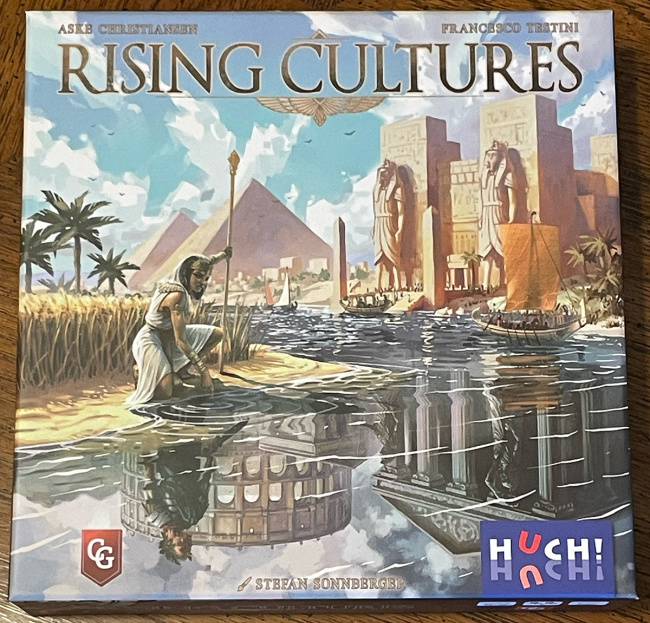

Rising Cultures
Publisher: Capstone Games
Designer: Aske Christiansen, Francesco Testini
Illustrator: Stefan Sonnberger
Number of Players: 2
Age Rating: 14 and up
Playing Time: 45 minutes
MSRP: $29.99
Product #: 8-50045-36594-3 (UPC)
Release Date: March 2026
ICv2 Rating: 3.5 Stars out of 5
Since the publication of the Francis Tresham classic Civilization, designers have been searching for a way to capture its essence in a package that did not require six hours to complete, with varying degrees of success. It is in this spirit that Capstone has delivered Rising Cultures, produced in partnership with German publisher Huch!, a quick-paced game about competing civilizations in the ancient world for two players. The question is, should this have been left to the sands of time?
Summary: Two players choose from four civilizations: Rome, Persia, Egypt, and the Abbasid Caliphate, each represented by its own unique player board and small deck of cards depicting that culture’s architectural achievements and most prominent leaders. Over seven rounds, they compete for supremacy by investing cards in four areas: resources, military, construction, and progress. The cards thus are multi-purpose, each potentially being used for any of those ends. But by committing a card to one use, there is a significant opportunity cost: the other functions of the card are lost.
Each round, a player uses three of the four cards in their hand, returning the last to their deck to be reused later. Cards assigned as resources provide a pool that is counted towards the cost to put other cards into play as buildings or leaders, but resources are not “spent”: one either has them or does not, though coins acquired through card play or by sacrificing cards can be spent to make up shortages. Buildings and leaders provide abilities either during the game or for scoring at the end. But just as importantly, each time a building or leader is played, one of the resource cards can be sacrificed for progress, reducing the available resources but unlocking culture-specific advantages. Or, cards can be committed to the military, which becomes important at the end of the round when the players compete for control of one of the seven province cards, which in turn award victory points and more abilities. At the end of the seventh round, points are compared and the player with the most glorious civilization claims victory.

Originality: While the technique is not unique to Rising Cultures, I have always had a fondness for games where cards serve multiple potential purposes. Balancing the opportunity costs against the benefits of using each card creates interesting decisions that feel meaningful. And the various purposes of the cards in this game interlock in a creative way that makes almost every turn seem weighty and important.
Presentation: Sonnberger’s art is lovely, capturing the feel of the ancient world splendidly, and it is nicely supported by the clear graphic work of Daniel Muller. The cover is interesting and engaging, though the title fades a little too much for my taste. The description on the back of the box is a bit too brief, I think, but it is supported by an excellent illustration of the game components in use. The heft of the box feels appropriate for its size, which is exactly as big as it needs to be with little wasted space.
Quality: The packaging and the components are really quite good. The tokens are thick and sturdy, as are the player boards. The cards are nice and flexible, but curiously all of my decks arrived with a curve to the cards. Nothing that couldn’t be corrected by flexing the cards back and forth a few times, but still curious. The rulebook is a little wordy, and could have benefited from more illustrations, but is nicely supported by examples of play. I really like the individual rulesheets that very clearly explain each culture’s unique mechanics and the effects of every card in their deck, but I was a little confused why they include some of the core rules that should have been in the main book.

Marketability: My biggest reservation here is the player count. At exactly two players, I feel that the audience is somewhat limited, which is unfortunate. I worry that the small footprint and the player limitation may be a hurdle for the game finding the audience it deserves. Once you open the box, however, the price seems reasonable for what you find inside, and the game offers enough variability to justify multiple outings, which is certainly a plus. Games and historical settings are a seemingly permanent marriage, of course, so I don’t see any obstacles in terms of the setting.
Overall: Rising Cultures is an appetizer-sized taste of the grand history of civilization, giving players an opportunity to guide the development of their civilization through a surprisingly deep and challenging series of decisions on how to best use severely limited opportunities in the most efficient and effective manner possible. It offers a meaty game experience in a very short playing time with reasonable replayability.
At the same time, it is limited by its two-player nature and gameplay that has limited direct interaction between them. With only four cultures to choose from, the potential combinations are limited, which may unfortunately reduce its long-term variability, and those who are a needler for historical verisimilitude may question the cultures that were chosen: While Egypt and Persia were (more or less) contemporaneous and Rome not too far distant from them, the inclusion of the Abbasids instead of other cultures from that earlier era was an interesting choice, considering the millennium separating them from the Persians.
I found the gameplay engaging and enjoyable, though wishing for a way to share the experience with more than two players and wanting more variability than the four cultures offered is why I’m giving this game 3.5 stars out of 5.
Source: ICv2


