
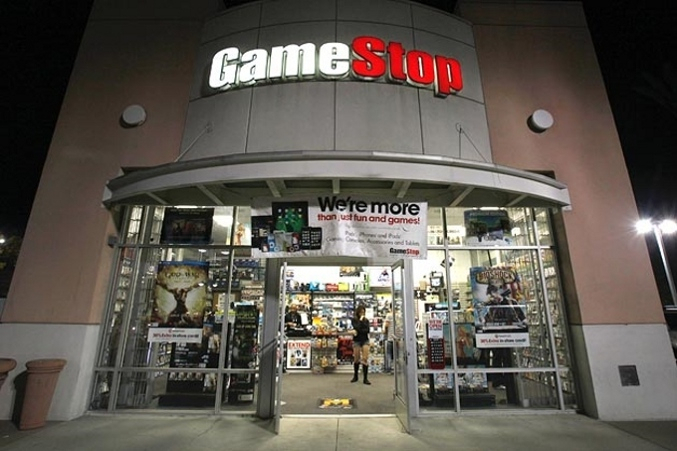

{IMAGE-2}The hundreds of U.S. stores GameStop closed in January 2026 (see “GameStop Closing Hundreds of Stores”) ended up being a relatively small fraction of the 727 stores it closed in its fiscal year ended January 31, 2026, the company revealed in its annual report. The closings came on top of nearly 1,000 stores closed in the previous fiscal year (see “GameStop Closed Nearly 1000 Stores”).
GameStop now has only 1,598 stores in the U.S. and 2,206 worldwide, down over 5,000 locations from the 7,500 locations it operated ten years ago. The process is apparently drawing to a close, at least for now; the company said it does not expect significant U.S. store closings in the current year.
With fewer stores (GameStop also exited the business in several countries last year), overall sales were down around 5% to $3.63 billion from $3.823 billion in the previous year. U.S. sales eked out an increase, to $2.67 billion from $2.58 billion in the previous fiscal year, but showed a big drop in Q4 as the store closings took hold. U.S. sales dropped to $788.5 million in fiscal Q4 from $861.1 million in the year ago quarter.
The store-closings continue to contribute to better operating results for the chain, which is relying on increased collectible sales to partially offset declines in video game hardware and software sales. Collectible sales were up 40% for the quarter ended January 31, to $365 million from $260.6 million a year ago. For the full fiscal year, collectible sales were up 48% to $1.06 billion from $717.9 million a year ago. Collectibles are now 29% of sales, up from 19% of sales in the previous year.
The share of collectible sales based on Pokemon TCG sales, of both new product and the slabbed singles it buys in stores and sells online, are now large enough for GameStop to call out collectible card demand as a risk factor for overall performance.
With collectible sales over $1 billion for the year, GameStop has now achieved a goal it set for itself ten years ago, a target it expected to reach by 2019 (see “GameStop Targets $1 Billion in Collectible Sales by 2019”).
The company’s venture into cryptocurrency speculation, announced a year ago, has not turned out as well. GameStop lost $151 million on its crypto assets in the quarter, and $131.6 million for the year.
But between operating profits and interest on the company’s cash hoard, GameStop was still nicely profitable for the quarter and year.
Operating income for the quarter was $135.2 million, up from $79.8 million in the same quarter a year ago. After non-operating items, including the crypto loss, interest on cash, and taxes, GameStop showed $127.9 million in profit for the quarter, down from $131.1 million a year ago.
For the year, GameStop had operating income of $232.1 million, a big improvement from the $26.2 million loss in the previous year. Net income including non-operating items was $418.4 million, up from $131.3 million in the previous year.
GameStop has announced that it is looking for a transformative acquisition in which to invest some of its $9 billion in liquid assets (see “GameStop Looking for Acquisition”).
Source: ICv2

