

Last week San Diego Comic-Con was briefly the Main Character on social media when anti-AI activists discovered the event’s policy allowing AI-generated work into its art show, albeit not for sale. This triggered widespread outrage and a rapid revision of the policy to one that bans bot-created slopwork in all cases. Huzzah! Victory achieved!
Meanwhile, two weeks ago, I was wearing my shoes out wandering the endless maze of the Consumer Electronics Show (CES) in Las Vegas, a weeklong showcase of the latest and greatest high-tech gadgets ranging from “smart” kitchen appliances to new iPhone cases to robot pet companions. Suffice it to say that a different attitude toward AI prevailed at this event, which was attended by around 150,000 people whose jobs largely depend on all the AI hype being true.
The peaks and valleys of this particular debate are enough to give you vertigo. Trillions of dollars are tied up in the minting of new chips, the building of data centers, and the infiltration of AI into every corner of life, and yet the hatred for it among consumers, ordinary workers, and, above all, creators, is both widespread and measurable. Recent polls show majorities of people dislike and distrust AI, oppose the construction of data centers, don’t use it productively at work, and worry about its impact on jobs.
These are big topics, but here at ICv2, we’re most concerned with what this means for comics. So here are a couple of competing perspectives.
AI will make your comics for you! Buried in the back of the “Eureka Pavilion” (startups showcase) at CES, in a space hosted by the South Korean government, I encountered a platform called Tooning, an AI-based education tool that has recently rolled out a one-stop AI “assistant” for making webtoons.
Thanks to the miracle of generative AI built on the plunder of work by real artists, you don’t need to write, draw, color or produce anything to make your comic! You just need an idea and some patience to work through some prompts. The founder walked me through a demo in which the user selects the genre and kind of story they want to do, then automates the creation of the script, the design of the characters, backgrounds, color choices, and page layout. Even “speech bubbles and sound effects are done by the smart scene placement AI,” according to the website.
We’ve seen versions of this concept before, based on the premise that comics-making needs to be “democratized” so that people with no patience, skills or experience can elbow their way into access to our attention (see “Shh! Don’t Tell These Digital Comics Startups that AI is a Bad Idea!”). But Tooning takes it a step further in terms of scale and idiot-proof simplicity. And considering the consistency in visual style of many mid-tier webtoons, it is easy to see why this fits the niche.
I wonder who besides investors sees this as a good thing. Certainly not creators, who care enough about their ideas to actually work on them and don’t relish competing against bot-lickers. Not platforms, who don’t want to be taken over by slop or face the reputational problems associated with it, not to mention the rats’ nest of copyright issues raised by AI-generated content. And probably not readers, at least not ones who have any discernment or taste.
But here it is, featured at an innovation pavilion at the world’s biggest tech conference. And, if you believe the company’s hype, it is already in use at thousands of locations, with huge numbers of active monthly users around the world. Good times.
Can AI be a tool for creative pros? There were a few products I saw demoed and discussed at CES that appeared to solve real problems in creative production, particularly around special effects and previsualization for movie production. But contrary to all the “democratization” hype, these tools appear to be every bit as specialized, purpose-built and expensive as high-end animation software you’d find in a studio setting. They are made for experienced professionals who already know what they are doing, and bury most of the AI magic behind sliders, dials and interfaces designed for people who know their craft so well that verbalizing their vision as a prompt is actually a bottleneck.
If you can get past the visceral reaction to generative AI, stuff like this might have a future in the right hands, even in comics. Last summer at SDCC, I spoke with graphic novelist and Afrofuturist creator Tim Fielder (Matty’s Rocket, The Graphic History of Hip Hop), who is an unapologetic proponent of AI as part of his art and his business.
Fielder talked me through his workflow, which uses an AI trained on his own work, developing visual concepts based on his own preliminary sketches, and finished in his own hand. Recently, he’s been experimenting with image-to-video tools to turn his art into animatics in his efforts to strike media deals for his properties.
Fielder’s craft and work ethic are beyond reproach. He’s been working professionally since the 1980s, has had his artwork exhibited in some of the most prestigious venues in the country, and still hustles constantly to get new projects off the ground. For him, AI isn’t a shortcut as much as a way to gain access to opportunities that might not otherwise be afforded to him, and to increase his creative surface area so he can make ends meet financially.
Opponents of generative AI could punch holes in all of this, of course. And Fielder is mindful of the ethical concerns. But for creators who already have their own voice, taste and style, specialized applications of AI seem closer to real tools than gimmicks. I wouldn’t be surprised if the industry finds some accommodation with them under constrained circumstances.
A tale of two narratives. The reality of today’s AI is that it is a potentially-useful tool for specialized applications being marketed as a cure-all for everyone, everywhere. In addition to the scenario described above, non-generative AI (machine learning) has all kinds of uses in science, engineering, logistics and finances. In comics, digital platforms are using it to help readers discover new content. It might even produce better market data, because it is good at inferring likely-accurate predictions from small data sets.
However, the scale of investment in AI vastly outstrips any possible return, even if the technology improves. It can’t survive as a money-making venture without adoption far beyond the use cases where it has real value. That’s why we’re hearing so much about an AI bubble (follow that link for a real education!), and why CEOs are getting increasingly desperate to silence all the criticisms.
Coming back to SDCC, it feels hard to blame them for a policy that the art show formulated two or three years ago, when it seemed reasonable to agree that “AI is coming whether we like it or not,” and try to find some accommodation with it. They were not the only ones in the industry taking that position, and it speaks well of them that they were willing to swiftly reconsider after hearing it from their fans.
These days, as the reality takes shape, it is better to mark our reactions and expectations to market. Tools that promise people the ability to prompt their way into becoming “real” artists and storytellers deserve our contempt. Ones that offer certain workflow efficiencies to professionals deserve our consideration, with the understanding that if the ethical compromises are too great or the finances don’t pencil out, we can get along ok without them too.
The opinions expressed in this column are solely those of the writer, and do not necessarily reflect the views of the editorial staff of ICv2.com.
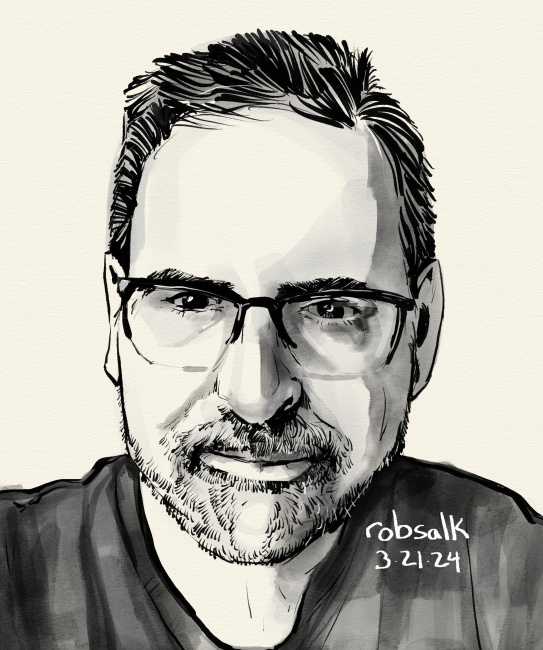
Rob Salkowitz (Bluesky @robsalk) is the author of Comic-Con and the Business of Pop Culture, a two-time Eisner Award nominee, and a proud longtime contributor to Eisner-nominated ICv2.
Source: ICv2

