1971 was shaped by revisions to the Comics Code Authority (CCA), issued in January 1971 — the first update since the Code’s creation in the 1950s. The revision stated:
“Scenes dealing with, or instruments associated with, the walking dead, or torture, shall not be used. Vampires, ghouls, and werewolves shall be permitted to be used when handled in the classic tradition, such as Frankenstein, Dracula, and other high-calibre literary works written by Edgar Allan Poe, Saki, Conan Doyle.”
Because of this change, Marvel introduced Morbius the Living Vampire, opening the floodgates to Gothic horror. By 1972, titles such as Tomb of Dracula, Werewolf by Night, and The Monster of Frankenstein carried that dark momentum forward, igniting the horror revival that would dominate comics for the next several years.
The top comics of 1971 were defined by four forces: Neal Adams’ dramatic covers, the soaring popularity of Amazing Spider-Man, Jack Kirby’s ambitious “Fourth World” saga at DC, and an unmistakably creepy tone. When Adams shifted Batman away from the cheesy (but lovable) 1966 TV era toward a darker, more serious detective, that mood rippled across the industry.
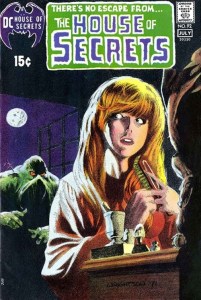
- House of Secrets #92 –

1st appearance of Swamp Thing. The pinnacle of this scary, dark mood in comics is showcased in this issue. A young girl, combing her hair, hears a sound behind her and starts to turn. The tension is palpable in this moment. As the outside viewer, we know that chaos and screams will soon overtake the scene. But Bernie Wrightson left us right here on the inhale before the scream, and that is the brilliance of Mr. Wrightson. - Batman #232 –
1st appearance of Ras Al Ghul. One of the ways that Neal Adams created iconic comic book covers was to make one or two figures larger than life. He grabs our eyes and focuses them exactly where he wants us to look. The focal point is much bigger than their surroundings in Detective #400, Batman #227, #230, #232, #234, and the most famous Batman #251 with the Joker. Ras Al Ghul is vampirish with long nails, a high collar, and an exaggerated cape, keeping with dark themes. - Detective Comics #411 –
1st full appearance of Talia Al Ghul. Talia is bound and guarded, in obvious peril, but Batman is equally in jeopardy. The great artists of the Bronze Age, like Neal Adams, offered readers a glimpse into something our hero could not see. That is the storytelling magic of this era’s covers — they invite you into the story. - Batman #234 –
1st Bronze Age appearance of Two-Face. A larger-than-life Two-Face drawn in purple and pink shades against a blue background sounds horrible, but it works. Neal Adams centers the cover on the gross side of Two-Face’s head, and you cannot take your eyes off it. It takes a while to even realize Batman is bound and in serious trouble. - Savage Tales #1 –
1st Appearance of Man-Thing. Looking at this powerful image of Conan the Barbarian, you can see that John Buscema built off the 60s artwork of Frank Frazetta. John Buscema’s cover evokes Frank Frazetta’s 1965 Conan the Adventurer paperback — Conan atop a pile of bodies, a woman clutching his leg. Buscema’s version channels that same primal power with his own raw energy. - The Amazing Spider-Man #101 –
1st appearance of Morbius, the living vampire. This is when we see Marvel taking advantage of the CCA revision, allowing vampires to haunt the pages again. Gil Kane created this dynamic cover with Morbius backhand slapping a six-armed Spider-Man. Values for this book have fluctuated over the years, with the highest points occurring during the COVID-19 hobby surge and prior to the release of the Morbius movie. Less than 1% of all 7,200+ issues submitted to CGC were graded at a 9.8. - The Amazing Spider-Man #100 –
1st appearance of the six-armed Spider-Man. For 1971, this is a very unusual cover with Spider-Man crawling over a negative image of friends and foes. The mostly black cover makes high-grade copies difficult to find. According to the CGC census, less than 2% are graded at a 9.8. - Mister Miracle #1 –
1st appearance of Mister Miracle and Oberon. I’m going to try to keep my fanboy attitude about Mister Miracle in check, but this is the greatest title of all time. (Well, that didn’t last long.) Kirby created this unique character; you never really know if he is a magician, an escape artist, or something different. His backstory involves the classic argument: Is it nurture or nature that molds you? A shockingly low 22 issues have ever been graded a 9.8, as reported by the CGC census. - Green Lantern #85 –

Speedy drug addiction storyline with the CCA approval. This is one of the most iconic covers from the era, showing drug use on the cover. There are similarities between this cover and Iron Man #128 with his alcoholism. Neal took the color from the background to focus attention on the three main characters. - Forever People #1 –
1st full appearance of Darkseid. Darkseid was teased in issues of Jimmy Olsen, but Forever People #1 has his full appearance. This is a psychedelic cover with some groovy dudes riding a funky three-wheeler. This is really the beginning of Kirby’s Fourth World, followed by New Gods #1 and then Mister Miracle #1. Kirby going to DC was huge news in 1970 and 71, and for good reason. He created or co-created so many great Marvel characters and then did the same at DC. - Pink Panther #1 –
1st appearance of the Pink Panther. It’s difficult to imagine today since he has been relegated to selling pink insulation, but Pink Panther was huge in 1971. Looking back, he was basically a pink Road Runner who was always outwitting the inspector instead of Wile E. Coyote. But kids loved him, so this book deserves to be on the top comics of 1971 list. - The Amazing Spider-Man #98 –
The third and final part of the anti-drug storyline. Marvel took a risk with a three-part storyline that didn’t include the CCA stamp. One month after this issue, DC released Green Lantern #85, with the CCA stamp. When you look at this cover, nothing openly gives you the impression that drugs will be discussed. It looks like a normal issue with Spider-Man fighting Green Goblin. - Mister Miracle #4 –
1st appearance of Big Barda. Several of the early issues of Mister Miracle, drawn by Jack Kirby, have fascinating covers. They are a combination of the rich imagination of Kirby and the ultimate escape artist. - Air Pirates Funnies #1 –

Underground issue using Disney’s trademarked characters. There were two issues produced before Disney’s lawsuit stopped it. The issues have the character in adult themes, not for children. - My Love #14 –
Woodstock cover. This is the one you weren’t expecting, isn’t it? Few covers capture a cultural moment so perfectly. Gray Morrow layered colors back to the stage with the main characters in all yellow with groovy outfits. The guy has a vest with fringe, a butterfly-collar shirt, and a mutton-chop beard; no wonder he is a heartbreaker. - The Amazing Spider-Man #97 –
Anti-drug storyline continues. This is the second of three issues dealing with drug usage. - The Amazing Spider-Man #96 –
1st mainstream comic without the CCA approval. The CCA revision of 1970 and then Marvel publishing this issue with no CCA stamp, started weakening the hold that they had for all of the 1960s. “Times they were a’ changing” - Marvel Feature #1 –
1st appearance of the Defenders. Neal Adams didn’t work for Marvel much, but when he did it was glorious. Instead of the typical fight scene, Neal adjusted it, allowing us to see the villain’s perspective. The Incredible Hulk is rampaging right off the page and into our faces. - New Gods #1 –
1st appearance of Orion, Highfather, and many more. The New Gods title doesn’t have the popularity that other Fourth World titles have, but issue one is packed with first appearances. - Superman #233 –
Iconic Neal Adams cover. Focusing solely on Superman, Neal changes the typical narrative. Instead of adding a new type of Kryptonite, like yellow or red kryptonite that causes amnesia, he says, “Kryptonite No More.” With one image, you know Superman is going in a different direction. - Batman #237 –
1st appearance of the Reaper. Minor character introduction, but a great looking skeleton cover, keeping the creepy, gothic vibes. - Weird War Tales #1 –
1st issue in a new title. DC blended scary with war comics to create this title. Over the series, most of the issues feature a skeleton, so it probably should have been named Skeleton War Tales. Joe Kubert drew long, slim figures regularly, so his work with skeletons works perfectly with his artistic style. - The Amazing Spider-Man #102 –
2nd appearance of Morbius. A Gil Kane cover that accentuates the six-armed Spider-Man. I understand the spider motif, but giving him six arms and two legs doesn’t work for me. - The Avengers #89 –
This is the start of the Kree-Skrull War. Sal Buscema uses color wonderfully to focus our attention on Captain Marvel. A Captain Marvel that is strapped to an electric chair and enjoying a full dose of antidepressant electricity. - Ghosts #1 –
1st issue in a new haunted series. Most of the early issues feature Nick Cardy covers. He was also working on Teen Titans during this timeframe while just finishing his 56-issue run on Aquaman.
Source: Comics Price Guide