
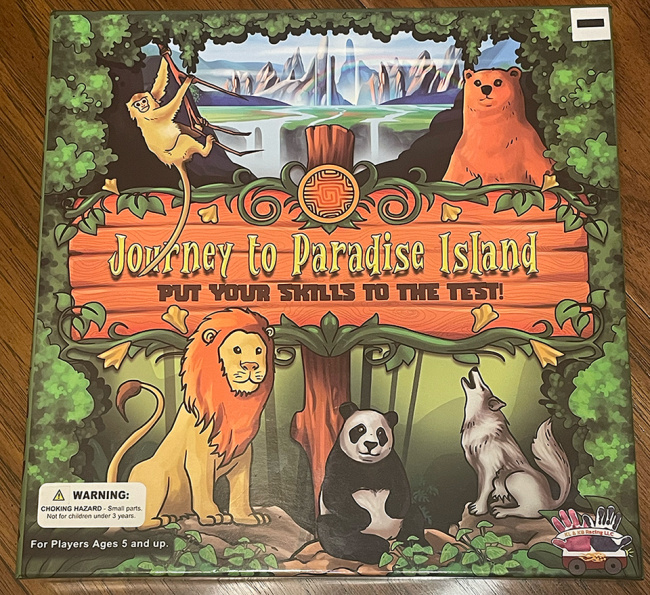

Journey to Paradise Island (Subtraction Version)
Publisher: KL & KB Racing LLC
Number of Players: 2 to 5
Age Rating: 5 and up
MSRP: $50.00
Product #: WG2300 2346
ICv2 Rating: 2.5 Stars out of 5
The educational value of games has been known for a long time. The ability of games to inject fun into the learning experience can help keep children engaged and involved in the activity much longer than more traditional formats. This can especially be true for the typically dry lessons of arithmetic and basic mathematics. That is the goal of Journey to Paradise Island. But does this quirky little game deliver fun, learning, or most importantly, both?

Summary: The game board shows a collection of winding and overlapping paths running from a desert to the verdant Paradise Island, the ultimate goal for any math-learning critter. Each path is assigned to a different wild animal and color coded to add in navigation. Where the paths intersect, an animal “arena” shows the animals of those paths sizing one another up in preparation for a showdown. Each player selects their favorite animal from the five available, locates their starting space, and they’re ready to go.
On their turn, each player rolls the die and moves their animal forward that many spaces. If they land on a space with instructions, they must follow them, possibly earning a bonus move, losing a turn, or drawing one of three types of cards: Success are good, Oh No! are not, Challenge varies. Should they land in an arena, they will need to confront a Math card, with a correct answer to the problem shown moving them forward and an incorrect answer moving them back. Should two animals land in the same arena at the same time, they must complete their Math cards face-to-face, with the faster player winning the challenge or, alternatively, the player who can answer more consecutive problems correctly winning the challenge.

Originality: At its heart, this is a “roll your dice and move your mice” style game, which has been a mainstay of children’s boardgames for as long as there have been children’s boardgames. They types of pitfalls and bonuses one encounters along their path would be perfectly at home in any title in that long tradition. The cards a player might encounter similarly call back to this tradition. The innovative concepts here involve the use of this proven system to create a comfortable and familiar environment for children to practice their arithmetic, and the added excitement of the occasional head-to-head contests in the arenas.
Presentation: The game box displays warm and comforting kid-friendly illustrations of the five animals cavorting in a jungle paradise, all in bright welcoming colors and soft lines that have long proven attractive to young audiences. The box is perhaps a little oversized for what’s inside, but the components are competently secured in the sturdy plastic tray. The art style carries through to the game board, though the color palette is somewhat subdued, which can sometimes cause a little confusion about which path is which. The cards are basically all text, which I think is a missed opportunity to include some cute illustrations to help keep kids engaged.

Quality: The production quality on the components is solid. The box is good and sturdy, the board is well-made, and the cards are nice and flexible to stand up to repeated play. It’s a little unfortunate that the movers are standees rather than miniatures, another missed opportunity for greater engagement, I think. The rulebook is, I’m sad to say, on the rough side. Rules are presented in an odd order, making it a bit of a challenge to learn the gameplay or look up rules during a game. It is also devoid of illustrations or examples of play, two things that in my experience are invaluable for teaching games. Fortunately, there are “how to play” resources easily accessible on the publisher’s website (though maybe adding a QR code might have been nice).
Marketability: Parents of young children are always on the hunt for fun educational opportunities for their children, and I think the graphics and style of play here would be attractive to the young’uns. But I think this may be hampered by the price point and by the choice to produce a separate version for each math operator. That limits the audience to typically a single educational season.
Overall: Using games to help teach math concepts to children is a valuable objective in my opinion. I am certain that my interest in mathematics (or at least my attention span) would certainly have benefited from this sort of approach. Journey to Paradise Island is a worthy attempt at that goal.
However, the gameplay has a few pitfalls that I worry might generate frustration by some players if they have consistently bad luck, and losing turns is never “fun” when you have to watch others keep playing. Also, I would much rather have seen the game include all the math operators in a single box, with instructions for how and when to add them to the game so the game could grow along with the students and extend its lifetime. The end result has a lot of positives, but I think it could have been much more.
That’s why I’m giving this game 2.5 out of 5.
Source: ICv2


