
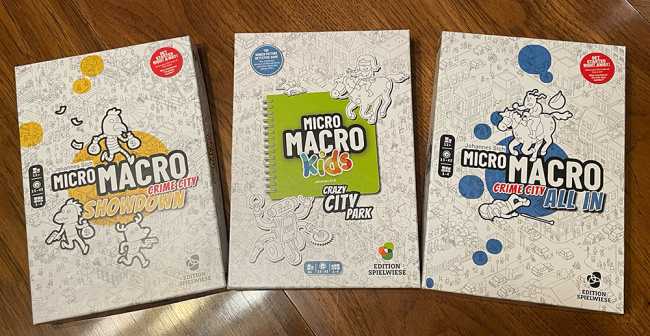

MicroMacro Crime City: All In; MicroMacro Crime City: Showdown; MicroMacro Kids: Crazy City Park
Publisher: Edition Spielwiese (via Hachette)
Designers: Johannes Sich, Daniel Goll, Tobias Jochinke
Illustrators: Vero Endemann, Leon Peters, Naemi Furst, Mathias Barth
Number of Players: 1 or more
Age Rating: MicroMacro Crime City: 12 and up; MicroMacro Kids: 6 and up
Playing Time: varies
MSRP: MicroMacro Crime City: $34.99 each; MicroMacro Kids: $24.99
Product #: ESMMCC03; ESMMCC04; ESMMK01
ICv2 Rating: 4.5 Stars out of 5
Late in 2020, as the world was still reeling from a global pandemic, a curious little game emerged from the clever folks from Edition Spielwiese: MicroMacro Crime City. They kindly allowed me to test out this little gem, which I found to be quite delightful (see “Review: ‘MicroMacro: Crime City’ (Board Game)”). Apparently the jurists at the prestigious Spiel des Jahres agreed, awarding the game the coveted Game of the Year award in 2021 (see “Winner of ‘Spiel des Jahres’ 2021 Unveiled”). In a lot of ways, this quirky little box was a perfect pandemic-era activity, combining elements of hidden image puzzles with deductive mystery solving for however many heads you could fit around its generously sized 75 cm by 110 cm poster.
Now Spielwiese has a new distribution partner for the series, working with Hachette Boardgames USA to distribute them in the U.S. Which begs the question, do they still have the same appeal now that we’re not trapped by Covid?

Summary: Each set is a stand-alone puzzle-game featuring a giant poster illustrated in fabulous detail with often-humorous, often-tragic scenes in tight black and white. The cleverness of the design is that the scenes represent action over time on the same page: by locating different appearances by the same characters, you can follow their movements and activities during the course of the day. Along with the poster, a deck of cards (or a lovely spiral-bound book in the case of MicroMacro Kids) presents a series of mysterious cases. The first card in each case presents the background and identifies its initiating character, typically the victim of some awful crime (it is Crime City, after all). The players must locate the individual in question on the poster, then begin the process of investigating what happened through clues in the illustrations and the other cards that make up the case deck. Reaching the final card reveals the terrible truth, assuming the players were able to deduce the right answers.
The cases vary in length and difficulty, from extremely easy to quite challenging, conveniently indicated by a number of stars on each case introduction. A welcome addition to the current version is a series of icons that indicate how suitable each case is for younger eyes, allowing families to decide whether to include the kiddies in the fun or save it for when they’re older. Of course, MicroMacro Kids is all family-friendly, replacing more mature themes with a more whimsical and humorous setting.
Originality: Each set stands on its own, but we were amused to discover that some of the same characters that appeared in earlier editions make an appearance, tying the different sets in the now five-game series together in a fun little way. I would have thought that new sets would be too repetitive to feel original, but I was pleased to discover that each offers new cases and new ideas that are just as much fun as the original design, despite the obvious similarities.

It is worth noting that the MicroMacro Kids set introduces some very nice improvements to the physical design. While the poster is quite a bit smaller to give an assist to younger players, replacing the decks of cards with a beefy casebook is delightful. It is much easier to lay out the book and flip the pages instead of herding stacks of cards. This set also adds a collection of bright green translucent chips that can be used to mark points of interest on the map, which are super helpful when trying to pull together all of the clues. They are handy enough that I recommend using a similar token for all MicroMacro endeavors.
Presentation: The hallmark of the entire series is its very subtle presentation. The components inside the game are all black and white (though the Kids set does add a splash of color in the casebook), and that aesthetic carries over to the packaging as well. In fact, the outside of the box is a copy of part of the poster, complete with a hidden mini-mystery you can try out before opening the game. This subtlety does little to attract attention, unfortunately, but it does a good job of highlighting what the game is about.

Quality: The quality of production is quite good, with a nice, sturdy box holding everything together. The poster is the same material as old-fashioned roadmaps (and folded much the same way), and the cards/casebook are excellent quality. The rules are clear and quite minimal, and the different complexity of the cases allows players to ease into the game as their skills develop.
Marketability: Cooperative style games and puzzle-like games continue to attract an audience, as do games that support solitaire play, and all of the MicroMacro titles offer both. The downside is that this is more of a puzzle than a game, so it is quite a different experience than I think most gamers might be expecting.
Overall: I was pleased to discover that diving back into the awful little lives of the MicroMacro citizenry was just as compelling now as it was before. The cases are still interesting, intriguing, and challenging enough to make one have to think a little bit, without burning out too many brain cells. The illustrations are just as amusing as before, with a touch of whimsy despite the horrible crimes depicted, keeping the entire activity fun and amusing. Even free from the bonds of pandemic life, I enjoy every visit to Crime City, and I find the silliness of the Kids version just as amusing. And that’s why I’m giving this game 4.5 out of 5.
Source: ICv2

