
Iliad
Publisher: Bitewing Games
Designer: Reiner Knizia
Illustrator: Harry Conway
Number of Players: 2
Age Rating: 10 and up
Playing Time: 30 minutes
MSRP: $29.00
Product #: BTW1200
ICv2 Rating: 4.5 Stars out of 5
Dr. Reiner Knizia is one of the world’s most prolific and celebrated designers, with numerous awards to his credit. With a reputation for well-conceived, solid designs, he has developed a loyal following over nearly three decades as a full-time designer. With so many titles under his belt, the question is whether Iliad, the first of Bitewing’s “Mythos Collection”, can fill the shoes of the demi-gods who inspired it?
Summary: The theme is pulled from the Homeric epic known by the same name, specifically the climactic duel between the greatest champion of Troy, Hector, and the mightiest Greek hero, Achilles. Their confrontation is recreated in a rather abstract method, using tiles of various values on a six-by-six grid, colored checkers-board style. Players only place their pieces in spaces that match their color, so every tile that is not along an edge will be surrounded by two opposing tiles in both its row and its column. And both rows and columns are important, because each time either is filled, the more powerful combatant there gets the best choice of reward and forces their opponent to accept the lesser (and often penalizing) one.
If that was all, there may not be much to entice, but the designer has ensured that every tile placement is an important decision. Except for the strength-5 tiles, every tile placed allows the player to manipulate the battlefield in some way, perhaps moving their own tile, moving an opponent’s tile, or flipping tiles over to negate their power entirely. Special “Dolos” tiles add another twist, taking as their value the sum of both adjacent opposing tiles. The result is an extremely fluid and constantly shifting tableau, where no tile can be relied upon and every turn requires careful consideration.
As a test between two gods-chosen warriors implies, victory here is not a simple matter of overpowering your opponent, too often the case in two-player games. Two paths present themselves: should only one player attract the “favor” of all five gods (and goddesses) by claiming the right combination of scoring tiles through winning rows and columns, that player is declared the victor automatically. Points, in contrast, count only should neither player, or both, earn the coveted favors.

Originality: While many of the mechanics in Iliad feel familiar, Dr. Knizia has molded them into an interesting and challenging form that feels fresh and new, requiring players to consider multiple aspects in tandem each turn. The tight hand limit of two tiles and the restriction to place only on same-colored spaces seem at first to limit a player’s options, but the fluid nature of the game and the clever scoring mechanisms create a robust decision space throughout the game.
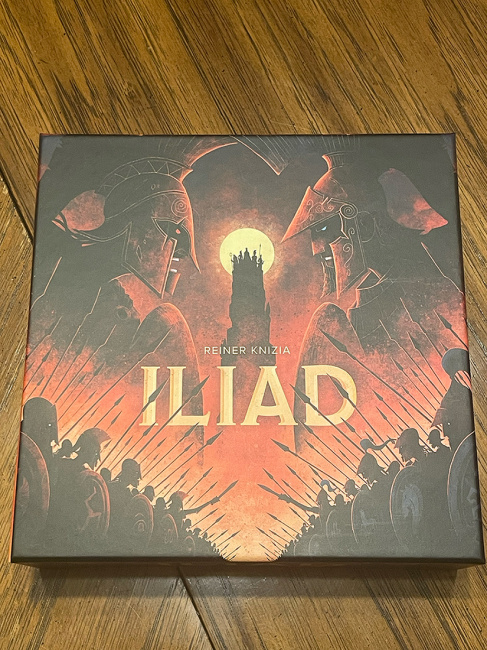
Presentation: The game box offers bold colors juxtaposed with dark shadowy forms to present a tense and dramatic scene that captures the emotional tension nicely, but I think the dark colors tend to make the imagery fade when viewed from a distance. Fortunately, the title is easy to read even from a few paces away. The back of the box offers an excellent description of the game along with a good illustration of the components. The artistic style is carried throughout the game components, creating a vivid, emotional tension well-suited to the game’s theme. The rulebook is clearly written, getting players into play quickly thanks to well-designed illustrations and examples.
Quality: The components are really quite lovely. In lieu of a game board, a printed cloth playmat is included, and the tiles are an extra-thick material, printed with easy-to-read values and icons for the special abilities, which gives the game a pleasing tactile feel. The palette is a little dark, but the colors should be easy to distinguish in different qualities of light. The scoring tokens are the same quality as the tiles, and offer a much broader color palette without becoming distracting or difficult to read.
Marketability: Few game designers enjoy such instant name recognition as Dr. Knizia, which offers Iliad a built-in fan base right off the bat. The two-player count could limit the potential audience, but on the other hand I have noticed a growth in the popularity of two-player games over the past few years, so this may prove not to be an obstacle after all. The game is a solid, middleweight “Euro” type game, a category that continues to find popularity in the hobby, but its abstract nature, heavy strategic elements, and level of randomness may turn off some.
Overall: Like most Euro-style games, the theme of Iliad hangs rather loosely, and the focus truly is on the mechanics and the interesting tactical puzzles they create. The rapidly shifting situation on the board makes long-term strategy challenging, but offers tremendous depth of tactical options even when a player has a “weak” hand, thanks to the fact that nearly every tile allows the player to manipulate the game state in powerful ways. The double-barreled victory conditions, something of a tradition in Dr. Knizia’s designs, adds an extra layer of strategy to the game and helps keep things competitive.
On the other hand, the game does have a significant random element that may frustrate players who prefer a “pure” strategy environment. Since a player only has access to two of their tiles at a time and the order they appear is random, even though both players have an identical set of options over the course of the game the timing of when those options become available can be a critical element. Personally, though, I feel that this adds to the overall experience more than it detracts, and the luxurious playing pieces are a joy to use. That’s why I’m giving this game 4.5 out of 5.
Source: ICv2