In 1967, when Neal Adams began producing cover art for DC, he was assigned to titles like Adventures of Bob Hope and Adventures of Jerry Lewis. These were slapstick humor books built on broad gags and exaggerated premises—already feeling dated even by late-1960s standards.
It didn’t take long for Carmine Infantino, then DC’s Editorial Director, to recognize Adams’ talent. Within a short time, Adams was moved onto core superhero titles, including Action Comics, Lois Lane, and The Brave and the Bold.
In a 1978 article, Neal said this: “One of the concepts I feel very strongly about is that rules are made to be broken. If you can break a rule and do it in an interesting and different way, then it’s almost your obligation to break a rule.”
Knowing this about Neal’s personality, it wouldn’t take long for him to start challenging the status quo of light-hearted Silver Age books of the late 60s.
Turning off the Lights
Over the next two years, Neal Adams began doing something subtle but transformative: he started turning the lights off. The shift away from the bright, airy Silver Age wasn’t immediate or absolute—it unfolded gradually, through deeper shadows, heavier atmosphere, and an increasing sense of unease.
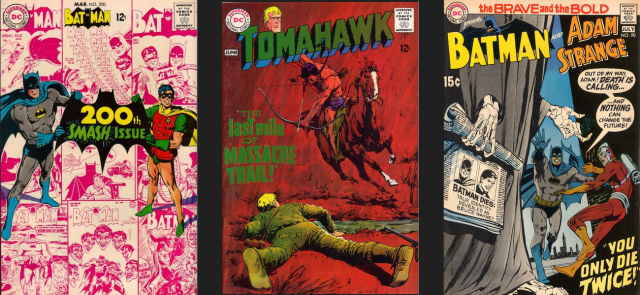
Let’s look at the books that he did prior to turning off the lights. In March 1968, Batman #200 still presents a comfortably Silver Age image: a bright, open composition with pastel tones and no real sense of danger. A month later, Superman’s Pal, Jimmy Olsen #110 depicts a barbershop scene that could easily have appeared in 1960—a small town problem with the cozy familiarity of The Andy Griffith Show.
Then the lights begin to flicker. Strange Adventures #212 abandons whimsy for brute conflict, freezing a fistfight in progress while a gun is raised just outside the frame. And by June 1968, Tomahawk #116 strips away superhero theatrics altogether, using a dried-blood palette and grounded realism to suggest that survival—not victory—is at stake. He has broken the rules, giving real consequences, not fun frivolity to some of his covers.
By the time the Bronze Age fully arrives, the flickering stops. The shadows no longer feel experimental—they feel intentional. On The Brave and the Bold #90, Neal Adams takes an Adam Strange and Batman team-up and layers in restraint rather than spectacle. The bright yellows of Batman’s emblem and utility belt are deliberately muted, a conscious choice that sets a mood far removed from traditional superhero exuberance. The light never fully returns. What began as a gradual dimming becomes the emotional baseline of the Bronze Age.

Catch a Feeling
Neal Adams once suggested that readers don’t remember comic books by their images, but by how those images make them feel. Looking back at his covers, that idea becomes impossible to ignore. Since his most iconic and expensive works have already been well documented, this section focuses instead on lesser-seen Adams covers—images that linger because of mood rather than notoriety.
At the start of the Bronze Age, DC Special #6 captures a uniquely layered feeling. A cowboy crouches behind his dead horse, rifle smoke drifting upward as a charging group of indians closes in for the kill. Their victory feels inevitable—until both sides are startled by the sudden arrival of a spaceship, their squabble forgotten as a larger threat looms. In a single image, Adams leads the reader through desperation, tension, relief, and dread. This is emotional control, not spectacle. He guides the reader the way a rider leads a horse down a dusty trail—one measured step at a time.
In 1972, Adams delivered a different kind of unease on The Phantom Stranger #17. A man sprints in blind terror along subway tracks, while the Phantom Stranger watches emotionlessly from a shadowed wall. The oncoming train is subtly transformed into a face—headlights as eyes, a darkened window as a nose, metal grating as teeth. Taken as a whole, the image radiates anxiety. Nothing explodes. Nothing resolves. The feeling is the point.

Mood grows into realism
A few years later, by 1974, the gothic shadows and heightened unease that defined Neal Adams’ earlier work began to recede. To Neal Adams, gothic was never a trap—it was an intentional choice. He could return to a foreboding atmosphere whenever the subject demanded it. But now his focus shifts toward realism without exaggeration.
On Deadly Hands of Kung Fu #4, the image doesn’t feel moody—it feels present. David Carradine’s Caine appears so grounded that he might step off the cover, speak in parables, and ask you to snatch a pebble from his hand. There is a quiet intensity in Caine’s eyes as an attacker is thrown behind him. In Kung Fu, Carradine’s performance was calm and understated, and Adams captures that restraint perfectly. The power comes not from tension or shadow, but from stillness and control.
By this stage in his career, Adams relies less on line work and more on brush strokes. Savage Sword of Conan #2 emphasizes Conan’s physical mass through lighting rather than exaggeration. In the background, a mystical presence rises from billowing smoke—a reminder that fantasy and realism can coexist. During his gothic phase, Adams used darkness to make the reader feel something. Here, even the unreal is presented calmly, as an accepted part of the world rather than an emotional device.
Another painted magazine cover from the same period, Marvel Preview #1, shows this evolution clearly. Light and shadow are still present, but they behave realistically. The ship emits a cold, directional glow that bathes the alien figure, while the cavemen in the foreground react through posture rather than expression. Highlights and shadows describe form and movement, not menace. Adams is no longer heightening reality—he is observing it.

In a 1978 interview with The Comics Journal, Neal Adams said, “I feel it’s my job to be a leader and to create new ways of telling stories.” That statement reads less like ambition and more like description. When Adams guided the carefree Silver Age into the shadowed corridors of the Bronze Age, he was leading. When he began prioritizing emotional storytelling—asking readers to feel unease, fear, and empathy rather than simply admire spectacle—he was leading again. And when he later embraced realism through larger-format magazines and painted covers, he did not retreat from comics; he moved ahead of them.
Gothic wasn’t rejected—it was contextualized.
Emotion wasn’t abandoned—it evolved.
Fantasy wasn’t removed—it was normalized.
From 1968 through 1975, Neal Adams was the central figure in redefining how mainstream superhero comics were drawn, lit, and emotionally experienced. Once the Bronze Age absorbed the storytelling tools Adams had introduced, he no longer needed to carry that weight alone. By the mid-1970s, the industry had changed. New voices began to expand the emotional and narrative possibilities he helped open. Including Chris Claremont and Dave Cockrum on X-Men, who would push character-driven storytelling in directions uniquely their own. Adams’ greatest legacy may not be any single cover or style, but the fact that once his innovations became the norm, he was already looking toward what comics could become next.
by Ron Cloer
Writing on Bronze Age comics, cultural history, and market significance
For a year-by-year list of the most expensive Bronze Age comic books and Bronze Age Creator Spotlights, see my archive page. Bronze Age Comic Book Archive
Source: Comics Price Guide