
Ichor
Publisher: Bitewing Games
Release Date: 2025
MSRP: $34.00
Product #: BTW1300
Designer: Reiner Knizia
Illustrator: Tyler Miles Lockett
Number of Players: 2
Playing Time: 40 minutes
Age Rating: 10 and up
ICv2 Rating: 3.5 Stars out of 5
Bitewing Games continues its “Mythos Collection” of two-player strategy games inspired by mythology with another title by the inestimable Dr. Reiner Knizia. Again drawing upon ancient Greek myth, Ichor imagines a brutal conflict between the gods and goddesses of Olympus and a menagerie of monsters. But is the gameplay divinely inspired?
Summary: At its core, Ichor seems at first to be a traditional sort of abstract strategy game. Built on a simple grid of six-by-six or seven-by-seven spaces, depending on which side of the double-sided game board is used, each player maneuvers their pawns across the board, claiming control of any spaces they move through. Pieces are blocked from entering an occupied space, and simply take over any space previously claimed by their opponent by moving through them. Victory is achieved either by trapping all of your opponent’s pieces or, more likely, by placing all of your control tokens on the board before you opponent can.
But things get more interesting when the character powers are considered. Each character has a single-use ability that allows them to alter the basic rules in a significant way. Some may move past or push opposing pieces, or move in unpredictable ways, while others can remove or replace control tokens on the board. Much of the strategy of the game hinges on the timing of these powers to maximize their effectiveness, as each character’s ability can be used only one time during the entire game. Since each character’s power is unique, and the combination of powers in play varies from game to game, understanding and utilizing these powers effectively is where the magic is.

Originality: To me, the most interesting element of this design, aside from the interplay of the character powers, is the idea that moving through the play area to claim control is the key to victory. The result is that the open spaces of the game board are often more important than the pieces moving within them. This presents unusual and interesting strategic considerations and rewards clever tactical moves and positioning of one’s pieces. While this is not a new concept in strategy games, it is uncommon enough to make Ichor feel fresh when combined with the character abilities.
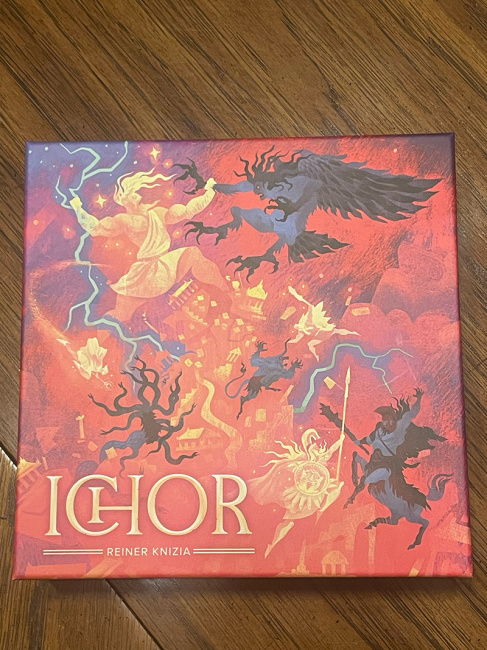
Presentation: Lockett’s artwork is dynamic and exciting, evocative of the mythology that inspired the game while giving a healthy nod to the artistic styles of the ancient Greeks. But while the box cover is full of action and drama, I feel that the color palette gives the impression that the artwork has faded, making some of the details hard to make out. I also found the game title a bit confusing, as it seems unrelated to the game theme or mechanics. On the favorable side, the box back offers a very nice description of the game and shows the components off quite nicely, and I find that I like the smaller box size since it has less “wasted” space and fits nicely on the shelf.
Quality: The components are very nice as well. The game “board” is a printed double-sided cloth mat amply decorated with a dramatic illustration of a besieged Olympus. The character standees are made from extra-thick cardboard with easily readable names. The control tokens are lovely wooden discs printed with an icon for their player, and the game cards are very good quality. The rules are clear and well written, though we did find the descriptions of some abilities could have benefited from a little more clarification. Alas, the rulebook does one thing that has always been an irritant of mine: including the rules for a game expansion that is not included in the box. I always feel that I’m being cheated to have rules that I can’t use because those components aren’t included.

Marketability: Dr. Knizia’s long career of solid game designs has gathered a number of loyal fans, which is always a plus, and two-player games seem to have been growing in popularity in recent years. The high-quality components and very reasonable price point are also positives for the design. The fact that the game has no hidden elements and no randomness should appeal to “pure” strategy players, while the mechanics are easy enough to learn that I don’t see any real barrier to entry here.
Overall: Ichor is the kind of game where the players get to “break” the rules to further their strategy through the use of their character powers. The interplay between these powers offers a lot of gameplay variety without becoming weighed down with an excessive ruleset. The tactical challenges and fun of the game emerges from these variables, creating a deep and engaging test of tactical acumen and strategic creativity. I enjoy the game and the puzzle of working out the best timing for the unique powers of my characters. Ichor offers a lot of depth for when you’re in the mood for a more “thinky” game that doesn’t require a huge time commitment to play.
But at the same time, the total open information and lack of any random or unpredictable elements results in a game that feels less casual and more like an intellectual challenge. Less of a relaxing pastime and more of a serious endeavor. While a bit more asymmetric than traditional abstract games, it still features many of the core concepts of that genre. This certainly appeals to a subset of game players, but at the same time is a turn off for others. And that’s why I’m giving this game 3.5 out of 5.
Source: ICv2