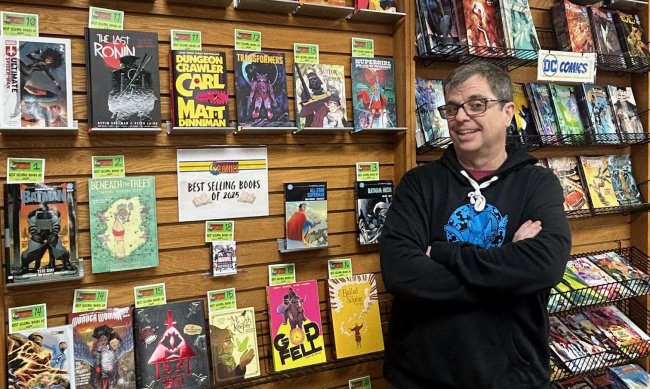

Hits and Misses will feature comic retailers sharing what’s working in their shop as well as the roadblocks they’ve been running into. In this case, “There are so many new faces,” Murray said of his year.
Captain Blue Hen Comics is a Newark, Delaware institution, and its community has fueled a tremendous year for the shop, with owner Joe Murray saying the store is up 21.7% this year. While new products are a big part of that story, with comics, trade paperbacks, and graphic novels all gaining by double digits, it’s the people that have driven it, with Murray sharing that foot traffic is up 20% in 2025.
“There are so many new faces,” he said.
The 2,000-square-foot shop has been swarmed by enthusiastic newcomers, and even though Murray isn’t sure what’s driven them into the store, he knows what connects them: they’re all eager to read the comics, trade paperbacks, graphic novels, manga, and back issues that have long comprised the shop’s product list.
While what it sells has stayed consistent, Murray’s time at Captain Blue Hen has been anything but that. His life has long overlapped with the shop’s own journey, as he quickly became a customer after Captain Blue Hen opened in 1980; he was hired as a clerk during a boom period for the industry in 1992; and when a downturn in the market and the shop’s staffing followed, he became the manager. By 2001, right before another strong period for comics, he bought Captain Blue Hen from its original owner, and he’s been riding the industry’s wave ever since.
It’s a lot to navigate. Thankfully, Murray has a team of five employees and his wife, bookkeeper, and co-owner Danielle to help him manage those ups and downs. But amidst the booms and busts the industry has gone through along the way, Captain Blue Hen Comics has had its own hits and misses to figure out.
Hit: Believe in Your Books
It can be a challenge for long-running shops to change. When you’ve been in business for as long as Murray has, it’s easier to stick to the basics. That’s why it helps to have staff members who remind you that pushing for more can lead to positive change. Murray found that in a former public-school librarian who once worked at the shop.
“We were doing an offsite event at a brewery that she took charge of, and she told me, ‘Believe in your books,’” Murray said. “And in a way I don’t always do.”
That lit a fire under Murray, and it changed how Captain Blue Hen did its business.
“As a result, we’re ordering much deeper on titles we believe in than we did in the past,” Murray said.
Murray would often order one or two copies of new releases, only getting replacements when necessary, but thanks to this shift in focus and a timely promotion by Penguin Random House (PRH), Captain Blue Hen Comics experimented by ordering more copies of some titles they believed in. It paid off.
“I found that my sales velocity on these titles was much faster than I would have expected,” Murray said. “Beneath the Trees Where Nobody Sees would have been a title I’d order one of and just kept replacing it. But PRH did a promotion, so I got six of them in. I’m selling four in a week.”
“I was losing opportunities to sell more,” he added.
That ethos has spread throughout the shop’s efforts. Captain Blue Hen is leaning into prose novels more because certain titles resonated with the staff, and that’s resulted in nine of their 20 best-selling books and trade paperbacks from the year being prose. Staff Pick signs were created, and that’s generated increased sales for selected releases. Believing in their books has led to some real wins.
“Our customers believe in us, and if we believe in the books, it works,” Murray said.
Miss: Planning to Fail
Part of the reason the first hit was so notable was because of how it contrasted with Murray’s typical approach.
“For much of my career, I planned to fail, which means if I was going to do an event or try a new product, I’d always plan it with an escape route,” Murray said.
To put it another way, Murray has always tried to mitigate risk, and that was true of products and events alike.
“Whenever we are planning an event, I’m fearful of it being successful to the point it ends up being too big to handle,” Murray said. “I don’t expect things to work as well as they do.”
Captain Blue Hen Comics has succeeded despite that risk-aversion, or even because of it at times. But for as much as putting a limit on orders or the size of your events can protect you from losses, it also lowers your ceiling, which is a problem. Murray has always approached things this way, but it wasn’t something he was fully aware of until he started believing in the books, which made him realize just how much planning to fail had cost them.
“It was my own reticence limiting everything; I am very conservative about ordering,” Murray said. “Seeing how believing in the books worked made me realize, ‘This is a flaw, and I need to look at it the other way.’”
“I’m trying to move away from that and see that these things can work, and you can still do them while minimizing risk,” he added.
Hit: Not Being Afraid to Ask
When he was originally an employee at Captain Blue Hen Comics, Murray realized if he stayed on his feet and looked for things to do, he’d get more accomplished. That created an obsession for him, one where he was always looking for ways to improve. The problem was, he didn’t know what he didn’t know, but he did have one advantage over many of his peers.
“I was never afraid to ask,” Murray said.
When he didn’t know something, he’d reach out to someone who did, and that’s been the backbone of his approach ever since.
“I was building relationships with publishers and distributors before that was a common thing,” Murray said. “I never would have been able to buy the store if I hadn’t.”
The relationships he made through his outreach and involvement with DC Comics’ Retailer Resource Program (RRP), which was a comic shop focus group, helped him acquire Captain Blue Hen Comics back in 2001. He connected with retailers like Brian Hibbs, Joe Field, Phil Boyle, and more, each of whom offered advice, with some even ending up on Murray’s small business loan application as advisors.
While that was a long time ago, that mindset has never left Murray. His network of retailers and publishers meant that if he needed something, solutions were only a phone call away, which was important for Murray.
“Making those connections and realizing that publishers want to work with you and want you to succeed…that was a huge thing,” Murray said. “If something’s not working for you, maybe they can come up with something to make it work.”
That isn’t always easy for retailers to do. Murray knows that when new stores open, they don’t necessarily understand that they can work with publishers. That’s what groups like ComicsPRO, the trade organization for comic retailers, help with. Murray is the President of ComicsPRO’s board, and he takes pride in how it makes asking for help that much easier for retailers, because he knows the power that can have for a comic shop.
“It was crucial,” Murray said. “It allowed me to think outside the box and be a bit more ambitious.”
Miss: Moving the Marketing Needle
Marketing and advertising have always been a struggle for Murray, but those challenges have been exacerbated by recent shifts in that space, as everything is decentralized in a way it hadn’t been previously.
“We used to do cable ads, but where would you put those now? Do you put them on a free streaming service?” Murray said. “Print is dead. Facebook algorithms change daily. Sometimes it feels like you’re creating free content and being a clown to entertain people who will never be near your store.”
Adapting has been a challenge for Murray, and he knows he hasn’t done enough marketing, even if previous efforts haven’t justified further spends. That’s a problem, but so is the fact that there’s a massive audience nearby he’s found difficult to penetrate.
“We’re next to the University of Delaware, but we have no idea how to market to get in there,” Murray said. “How would I advertise to them? Does anyone actually read? They obviously don’t watch cable television. So, there’s no way for us to figure out how to get in.”
While students do come in, seniors at the University will visit and are surprised to discover that Captain Blue Hen Comics was there the whole time despite being less than half a mile away. Murray regularly wonders what marketing levers could be pulled with students, because making inroads with them could make a huge difference.
“There’s a big audience for us that doesn’t know we exist or where we’re at,” Murray said.
Hit: Aiming for a Smile
Murray long knew that Captain Blue Hen Comics needed a mission statement, but he struggled to put into words what differentiated the shop.
“I always strived to find the bit that if I were to suddenly open another store and had to hand the book over to somebody and say, ‘This is how you reflect the personality of Captain Blue Hen,’” Murray said. “And I finally came up with it. Aim for a smile.”
That’s their goal every time someone walks in the door, and they did it long before that mission statement was formalized.
“For us, that usually means bad dad jokes,” Murray said. “When you’re coming here, you get a show and a product half the time. For example, all day today, people were coming into pre-recorded applause.”
Aiming for a smile builds connections with Captain Blue Hen’s customers, but it’s more than just gags. It informs all the decisions they make at the shop, as they always try to look on the brighter side of situations.
“It helps when little things go wrong,” Murray said. “How are we going to make lemonade out of this? Well, we’ll lean into it and do something fun with it.”
An example came in the form of a comic collection they acquired that was filled with releases from the black and white boom of the 1990s. It included key comics, but it was also loaded with plenty of less desirable material. These comics were a tough sell, so they created “Caveat Emptor Mystery Boxes,” collections of 100 or so comics that dared readers to find anything worth reading. It also included a gift and at least one autograph, but what customers didn’t know was that it was always a gag gift and a signed photo of Murray wearing a Captain Blue Hen mask. They were a hit with customers, who found them to be an entertaining challenge.
“It builds on the sense of community that we’re trying to develop,” Murray said. “If it’s not going to be fun, we’re not going to bother to do it.”
Hit and Miss: Reading the Road Ahead
Murray has always prided himself on how ahead of the curve Captain Blue Hen Comics typically is. The shop committed to graphic novels early on, they had a healthy manga selection before the boom, and its kids section preceded that market’s explosion, each of which ensured customers found the products they were looking for. Those are good things, and Murray sees his ability to read the road ahead as a hit for the shop…but also a miss.
“I spend so much time reading the road ahead that I am not in the moment at all,” Murray said. “If I wanted to write a memoir, I would have to interview other people to tell me about my life because I have no recollection of it.”
“It’s a good business practice,” he added. “But it’s also a bad personal practice.”
His role as the President of the Board of ComicsPRO means that he’s always looking forward on multiple levels, which costs him time from the here and now. That’s good for his business and the members of ComicsPRO, as it ensures they’re aware of pain points before they arrive, but it often means he gets all the grind of working retail without the fun that comes with. That work-life balance is something he’s working on, but it’s very much a work in progress.
“Somebody needs to be reading the road ahead,” Murray said. “But I wish I spent more time in the present so I can remember it when it becomes the past.”
Click Gallery below for full-size images of Captain Blue Hen Comics!
Source: ICv2